|
|
|
|
|
|
|
|

|
Don't Miss Any Special Deals - Sign Up To Our Newsletter!
| ||||||||||||||||
| CLICK HERE FOR A FULL LIST OF ALL IVAN BERRYMAN PRINTS BY TITLE |
|
Ivan Berryman Art  Postcards Postcards  Naval Postcards Naval Postcards |
[UP] - Aviation Postcards - Naval Postcards |
| Navigation | |
| Page 5 of 11 | Previous .. Page 5 .. Next |
|
|
|
|
|
|
|
|
|
|
|
|
|
|
|
|
|
|
|
|
|
| Navigation | |
| Page 5 of 11 | Previous .. Page 5 .. Next |
| Text for the above items : |
The Tenacious Belleisle by Ivan Berryman. (PC) Few ships fought more bravely than HMS Belleisle at the Battle of Trafalgar. Having been second in the line of Collingwood’s leeward division, the 74-gun Belleisle took on a number of opponents including the Monarca, Santa Ana and Indomtable, but soon found herself surrounded by enemy ships that poured weighty broadsides into her. By 2.30 in the afternoon, Bellisle was little more than a floating wreck, having lost all of her masts and bowsprit, yet still she fought bravely on, her colours flying defiantly from the stump of her mizzen mast. Belleisle survived her ordeal and was towed to Gibraltar after the battle where temporary repairs were made, arriving in Plymouth for a refit on 5th December 1805. |
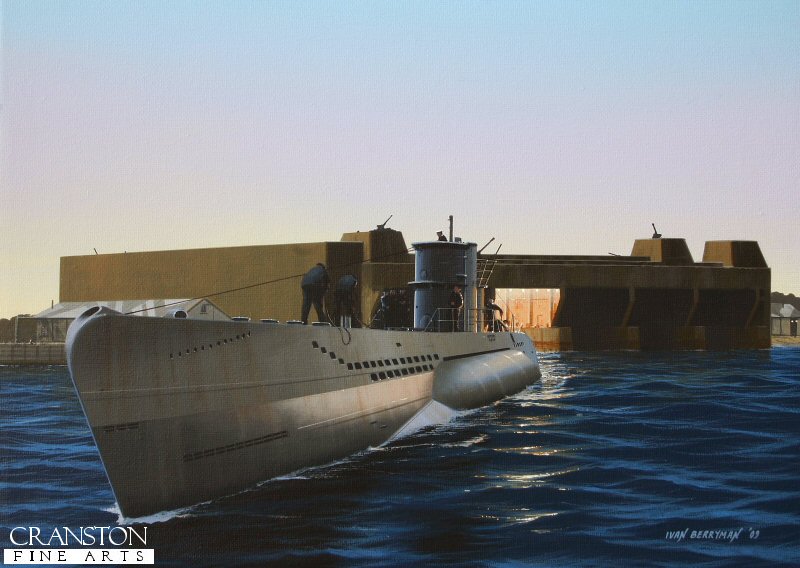
Dawn Departure by Ivan Berryman. (PC) A Type VIIC U-Boat slips quietly toward the open sea from her pen at Lorient, France in 1942. |
HMS Trafalgar by Ivan Berryman. (PC) Launched on 1st July 1981, the SSN Fleet Submarine HMS Trafalgar (S107) entered service with the Royal Navy in May 1983 and enjoyed an active career until her retirement at the end of 2009 at her home base of HMNB Devonport, Plymouth. |
Into the Storm by Ivan Berryman. (PC) Typical of the many hundreds of craft that took part in the 6th June 1944 landings at Normandy at the opening of Operation Overlord, these unarmed Royal Navy Landing Craft (LCAs) bravely transported many thousands of British and Canadian infantry to the beaches under the most intense fire. |
NTG03 - Task Force to Iraq by Ivan Berryman (PC) Key ships of the British task Force sail in close formation in the Mediterranean Sea during the build-up to the coalition liberation of Iraq in march 2003. Ships pictured left to right, include ATS Argus (A135), a Type 42 destroyer in the extreme distance, the flagship HMS ark Royal (RO7), RFA Orangeleaf (A110), LSL Sir Percival (L3036), the Commando and helicopter carrier HMS ocean (L12) and the Type 42 destroyer HMS Liverpool (D92) |
The Mary Rose by Ivan Berryman. (PC) Often reported to have had a brief and tragic career, Henry VIII's warship Mary Rose in fact enjoyed 34 years of service in what was then known as the Navy Royal. There is uncertainty about the date and whereabouts of her original construction but, having being bought into the King's Navy, she first saw action in 1512, the first of many skirmishes with the French. In 1522, she was put into reserve and was eventually refitted between 1535/36. Exactly how much her appearance changed during her refit is not known but she was back on front-line duty for the Battle of the Solent - again against the French fleet - in 1545. It was during this action that she mysteriously heeled over and sank, although no one knows for sure exactly why. The Mary Rose lay on the seabed until 1982, when her substantial remains were raised and preserved for all time at Portsmouth, where she can be viewed today. |
Battle of the Nile by Ivan Berryman. (PC) Sunset over Aboukir Bay on 1st August 1798 as ships of the Royal Navy, led by Nelson, conduct their ruthless destruction of the anchored French fleet. Ships shown from left to right. HMS Orion, Spartiate, Aquilon, Peuple Souvrain, HMS Defence, HMS Minotaur and HMS Swiftsure |
Lone Wolf by Ivan Berryman. (PC) The Type VII U-Boat became the standard design for German submarine warfare during the Second World War, sometimes hunting in packs, but more often alone. This Type VIIC has just claimed another victim, surfacing under the cover of night to observe the fiery demise of another victim. |
Richelieu and HMS Cumberland 1945 by Ivan Berryman. (PC) The French battleship Richelieu with the Royal Navy cruiser HMS Cumberland, shown during Operation Crimson after bombarding Sabang during July 1944. Grumman Avengers from the Royal Navy aircraft carrier HMS Vengeance shown overhead. |
HMS Malaya at Capetown, South Africa. by Ivan Berryman. (PC) The Queen Elizabeth class battleship HMS Malaya is pictured at Capetown in April 1942 en route to Durban from Gibraltar. A veteran of the First World War, Malaya took part in the Battle of Jutland, receiving eight hits, and going on to serve throughout World War Two, surviving a torpedo off Cape Verde in 1941. She is seen here about to recover her Fairey Swordfish floatplane beneath the dramatic outline of Table Mountain. |
A Night Action off Cadiz by Ivan Berryman. (PC) Skirmishes between frigates were a common occurrence, such as here when the 32-gun HMS Amphion encountered a French opponent off Cadiz in 1806 the latter, to her great cost, straying among the British inshore squadron in the darkness of a moonless night. It is understood that the French vessel managed to escape being taken as a prize, although with much damage to her whales and rigging. |
U-269 by Ivan Berryman. (PC) Type VIIC U-Boat U269 during an engagement in the English Channel with a B24 Liberator from 224 Squadron based at St Eval in Cornwall. |
The Aircraft That Found the Bismarck by Ivan Berryman. (PC) In early May 1941, in conditions of strict secrecy because the United States was not yet at war, seventeen pilots of the US Navy had arrived in Britain and been attached to Catalina squadrons of Coastal Command. These experienced PBY pilots were there to assist the Royal Air Force to become familiar with the Catalina, and also to gain operational experience for the US Navy. On 26th May 1941 Catalina Z of No.209 Sqn, commanded by Flying Officer Dennis Briggs RAF, with Ensign Leonard B Smith USN as co-pilot, joined the search for the Bismarck. At 1015 the aircraft was being flown in poor visibility at an altitude of 500ft when Ensign Smith sighted the Bismarck at a range of eight miles. The Catalina was flown towards the contact so that a positive identification could be made and emerged from the cloud only 500 yards from the German ship. The aircraft met a hail of anti-aircraft fire but was able to make its escape. As a result of the sighting report from Catalina Z the Bismarck was again engaged by ships and aircraft of the Royal Navy and was sunk at 1040 on 27th May 1941. Leonard Smith can be considered therefore, the first American to be directly involved in action in World War Two. He was awarded the Distinguished Flying Cross (American) for his actions. |
RFA Stromness at San Carlos Water by Ivan Berryman. (PC) No text for this item |
U-861 - Tribute to Jürgen Oesten by Ivan Berryman. (PC) Launched in 1943, U-861 was a Type IXD2 submarine commanded by Jürgen Oesten. Having previously commanded U-61 and U-106 successfully, he took U-861 to the Far East on a journey that took several months, sinking ships off Brazil and Madagascar on the way. Returning in early 1945, the submarine struck an iceberg off Greenland but managed to reach Trondheim in Norway without any casualties. Here, the U-boat was surrendered. Scuttled off the north of Ireland by the Allies, the wreck is now a dive site. Jürgen Oesten was awarded the Knight's Cross and sunk a shipping tonnage in excess of 100,000. He died in 2010. |
Cutty Sark by Ivan Berryman. (PC) Surely one of the most beautiful of the clipper ships, Cutty Sark is seen driving through a moderate swell en route to the UK with another valuable cargo. She was designed by the great Hercules Linton and her beautiful hull built by Scott & Linton's Dumbarton shipyards but, when that company went bankrupt, the nearby firm of Denby Brothers took over to complete the build. Today she is a magnificent sight, beautifully preserved and on display at Greenwich in London. |
HMS Javelin at Dunkirk by Ivan Berryman. (PC) HMS Javelin was launched at the John Brown Shipyard at Clydebank on 21st December 1938 and operated with the 5th Destroyer Flotilla under Lord Louis Mountbatten. She distinguished herself during Operation Dynamo, the evacuation of Dunkirk, and saved many lives from the sinking SS Abukir on the same mission. Later that year, Javelin came under attack from German torpedoes and gunfire, losing her bow and stern and over 90ft of her length, but she was rebuilt and served well throughout WWII. Finally scrapped at Troon in Scotland in 1949. |
The Bombardment of Tripoli, 1804 by Ivan Berryman. (PC) Ships of Commodore Preble's Mediterranean Squadron are shown during the action of 3rd August 1804 when they provided support to the gunboats and mortar boats as they pounded the defensive walls and xebecs that were defending Tripoli. In the left foreground, the bomb boat Robinson rolls as she fires her mortar whilst the brig Argus takes up station behind Constitution, both of which are firing broadsides. The brig Syren is in the far distance, engaging more of the Tripolitan xebec gunboats, having cut inside of Constitution to engage the enemy more closely. |
Tugging the Tiger's Tail by Ivan Berryman. (PC) It is the Battle of Trafalgar, 21st October 1805 and the British 2nd rater Temeraire with 98 guns, having followed HMS Victory through the Franco-Spanish line, finds herself alongside the Spanish flagship, La Santisima Trinidad. This giant was by some measure the largest warship in the World, boasting four full gun decks and 130 guns. Undaunted, Captain Eliab Harvey took on the Santisima Trinidad, delivering a number of blows into the enemy’s massive red and black hull. However, Temeraire was largely out of control by this time, having taken much punishment as she had approached the enemy fleet. Her main topgallant mast had been shot away, as well as the mizzen topgallant. Her fore yard had crashed down onto her deck and her fore topsail had caught fire and been extinguished. Taking fire from both sides, the Temeraire lumbered on, eventually colliding with Le Redoutable, which was engaged with Victory. Between them, the two British three-deckers poured fire into the French ship until it struck its colours |
Tribute to Midget Submarine HMS XE-3 by Ivan Berryman. (PC) The midget submarine HMS XE-3 made a successful attack on the Japanese cruiser Takao in Johore Strait, Singapore on 31st July 1943. Having evaded anti-submarine defences to reach their target, the Commander Ian Fraser and his diver James Magennis are shown preparing to attach limpet mines to the cruiser. Fraser then managed with great skill to position the main explosives directly under the ship before retreating back through the defended waters to safety. Both were awarded the Victoria Cross for their actions that day. |
Broadside - HMS Victory by Ivan Berryman. (PC) HMS Victory unleashes a fearsome broadside volley. During the ship's most famous battle at Trafalgar, the four decks carried over 100 guns in total, with each broadside capable of firing over a ton of cannonballs. |
|
Contact Details |
|
Sign Up To Our Newsletter!
This website is owned by Cranston Fine Arts. Torwood House, Torwoodhill Road, Rhu, Helensburgh, Scotland, G848LE Contact: Tel: (+44) (0) 1436 820269. Email: cranstonorders -at- outlook.com |
 |