|
|
|
|
|
|
|
|

|
Don't Miss Any Special Deals - Sign Up To Our Newsletter!
| ||||||||||||||||
| CLICK HERE FOR A FULL LIST OF ALL IVAN BERRYMAN PRINTS BY TITLE |
|
Ivan Berryman Art  Postcards Postcards  Naval Postcards Naval Postcards |
[UP] - Aviation Postcards - Naval Postcards |
| Navigation | |
| Page 6 of 11 | Previous .. Page 6 .. Next |
|
|
|
|
|
|
|
|
|
|
|
|
|
|
|
|
|
|
|
|
|
| Navigation | |
| Page 6 of 11 | Previous .. Page 6 .. Next |
| Text for the above items : |
U-552 by Ivan Berryman. (PC) Erich Topps notorious Red Devil Boat, U-552, slips quietly away from the scene of another victory in the North Atlantic in 1941. |
SMS Emden by Ivan Berryman. (PC) SMS Emden served in both Chinese and Pacific waters and was at the German colony of Tsingtao when war broke out. She was ordered to start raiding and disrupting commercial vessels in the Indian Ocean until she was cornered by HMAS Sydney. She was beached after the battle on 9th November 1914 and the wreck was partly scrapped by the Japanese in 1950. Some of her crew managed to reach Germany again after capturing a ship and traveling to Mecca. |
Bismarck at Hamburg by Ivan Berryman. (PC) Bismarck, now complete and newly painted in full Baltic camouflage, returns to Hamburg for the last time as the harsh winter of 1940/41 relents and the pride of the German Kriegsmarine prepares for real action. In the distance, the pre-Dreadnought Schleswig-Holstein awaits her next commission, the old ship alternating between vital ice-breaker and air defence duties at this time. |
Against All Odds - Attack on the Scharnhorst by Ivan Berryman. (PC) Swordfish of 825 Sqn led by Lt-Cdr Esmonde begin their heroic attack on the battlescruisers Scharnhorst and Gneisenau and the heavy cruiser Prinz Eugen as they make their way up the English Channel from Brest during Operation Cerberus on 12th February 1942. Although all the aircraft were lost and no significant damage was done to the German fleet, all the pilots were decorated for their bravery and Lt-Cdr Esmonde received the first Fleet Air Arm VC to be awarded, albeit posthumously. The painting depicts the first wave of Swordfish attacking the Scharnhorst with Gneisenau taking avoiding action in the distance. A German torpedo boat has turned to confront the attacking aircraft. |
The Temeraire's Last Journey by Ivan Berryman. (PC) Few ships have been immortalised in art more than HMS Temeraire, a 98-gun veteran of the Battle of Trafalgar and iconic subject of JMW Turner's memorable painting. Although one of the finest paintings ever produced, it is known that Turner's version of this magnificent old ship's voyage to the breaker's yard is pure whimsy, composed to inspire pride and sentiment in equal parts. This painting is, perhaps, a more truthful rendering of the same scene. Here, the mighty Temeraire is reduced to a floating hulk, stripped of her masts, bowsprit and rigging, her bitumen-coated hull gutted of anything useful. It is 7.30am on 5th September 1838. As the tide is judged to be just right, the steam tugs Sampson and Newcastle, piloted by William Scott and a crew of 25, take up the strain of the Temeraire's 2,121 tons to begin the slow journey from Sheerness to Rotherhithe, where she will be slowly taken to pieces at the yard of John Beatson. Whilst HMS Victory stands today in all her magnificence at Portsmouth, barely a trace of the ship that came to her rescue at Trafalgar exists. |
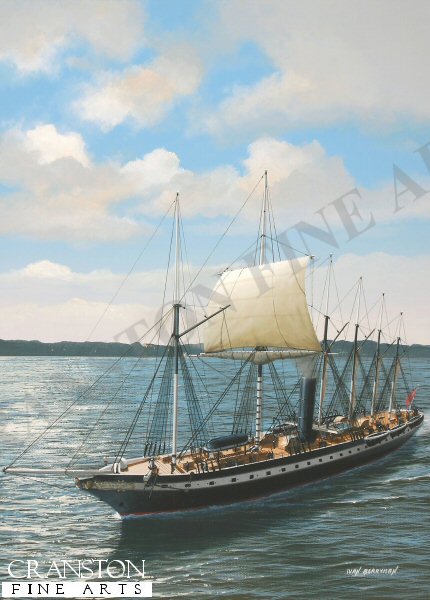
SS Great Britain Off Cowes by Ivan Berryman. (PC) One of Isambard Kingdom Brunel's most elegant designs, the 322ft long SS Great Britain of 1843 was the first ocean-going vessel to be made entirely of metal and also the first to be propeller-driven. She enjoyed a long and varied career before being abandoned as a hulk in the Falkland Islands at the end of the 1800s. In 1970, she was brought home to Bristol where she was fully restored and can be visited today. She is depicted in the Cowes Roads after her epic rounding of The Lizard on her maiden voyage, during which she had encountered - and survived - a violent storm. |
HMS Ark Royal III by Ivan Berryman. (PC) Legendary during her brief wartime career, Ark Royal heralded a new era in aircraft carrier design, possessing tremendous hull rigidity and a formidable array of defensive armament. Apart from her key role in Force H in the Mediterranean and the North Atlantic, Ark Royal also took part in operations off Norway in company with HMS Glorious. It was one of her Blackburn Skuas that claimed the first aerial victory of WWII against a German aircraft on 26th September 1939 and one of her Fairey Swordfish that crippled the mighty Bismarck, leading to the German capital ship's destruction at the hands of the Royal Navy. On 13th November 1941, Ark Royal was torpedoed by U-81 off Gibraltar, her severe list causing flooding to choke her boilers, bringing her to a standstill. Her crew were taken off and the mighty Ark continued to list until she eventually capsized and sank. |
Assault from the Deep by Ivan Berryman. (PC) Sitting menacingly at a depth of 15 metres below the surface, just 2 km outside the heavily defended harbour of Alexandria, the Italian submarine Scire is shown releasing her three manned torpedoes, or Maiali, at the outset of their daring raid in which the British battleships HMS Queen Elizabeth and HMS Valiant and a tanker, were severely damaged on 3rd December 1941. All six crew members of the three Maiali survived the mission, but all were captured and taken prisoner. Luigi Durand de la Penne and Emilio Bianchi can be seen moving away aboard 221, whilst Vincenzo Martellotta and Mario Marino (222) carry out systems checks. Antonio Marceglia and Spartaco Schergat, on 223, are heading away at the top of the picture. |
HMS Dido by Ivan Berryman. (PC) HMS Dido was launched on 18th July 1939, she took part in the evacuation of troops and defense of Crete, where she was damaged on B gun, killing 46 men. HMS Dido took part in the second Battle of Sirte during 1942, she sank three supply ships off North Africa. She also took part in the Anzio landings and the invasion of Southern France in August 1944. |
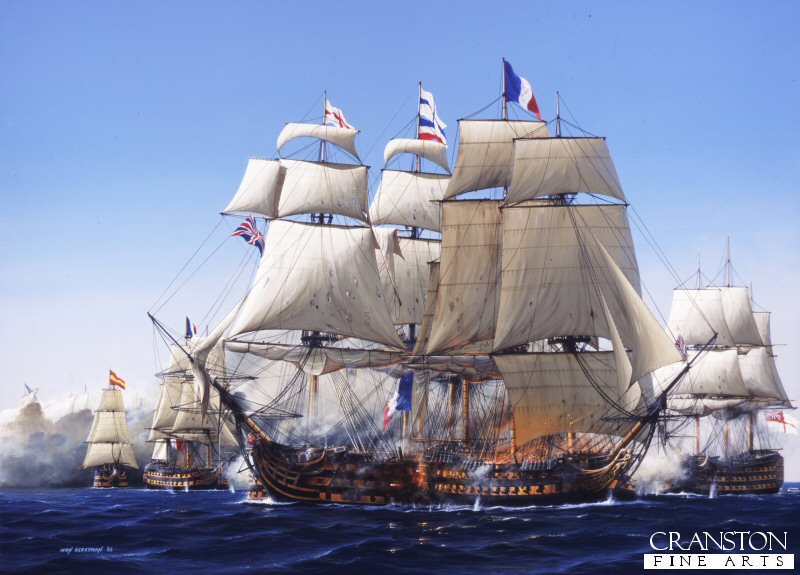
Breaking the Line by Ivan Berryman. (PC) Just seconds from opening fire with a broadside that will devastate her opponent, HMS Victory prepares to pass the stern of the French flagship Bucentaure, closely followed by the three-deckers HMS Temeraire and HMS Neptune. With guns unable to bear on the enemy fleet during the slow approach the British ships had endured terrible punishment with Victorys sails holed, her wheel smashed and her mizzen top shot away. |
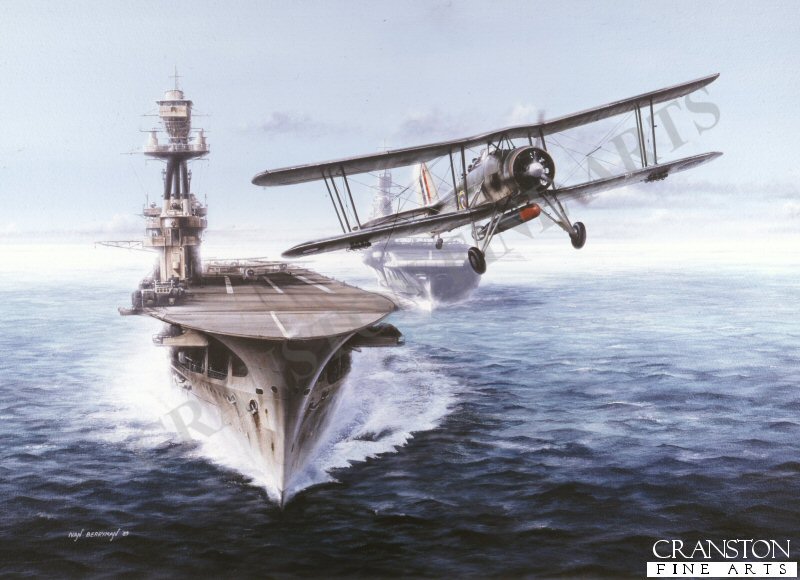
Viceless Lady by Ivan Berryman. (PC) A Fairey Swordfish launches from the Royal Navy aircraft carrier HMS Eagle in 1939. HMS Eagle would later fall victim to German U-boat U-73 on 11th August 1942. |
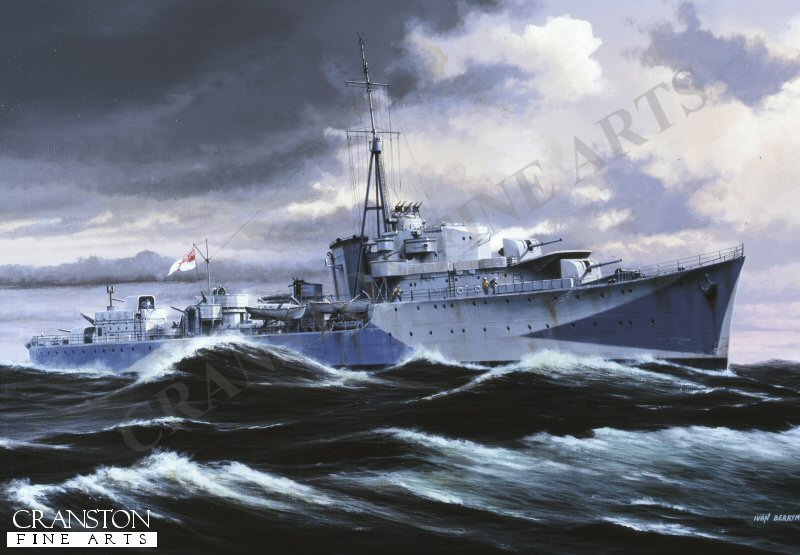
HMS Onslaught by Ivan Berryman. (PC) With her pennant number GO4 painted out to accommodate a western approaches camouflage the destroyer HMS Onslaught punches her way through a heavy swell during escort duties in the north Atlantic. |
HMS Resolution - Polar Explorer by Ivan Berryman. (PC) Originally a North Sea Collier named the Marquis of Granby, HMS Resolution was purchased by the Royal Navy and fitted out with all the very latest navigational aids and a water purification system in readiness for Captain Cook's second voyage to the Pacific in 1772. During this voyage, in 1773, Resolution became the first ship to cross the Antarctic Circle, entering the southern polar region on three occasions. Resolution was also Cook's choice for his third voyage in 1776 when she crossed the Arctic Circle twice in 1778 and 1779. Following her voyages of discovery, she returned to cargo duties, but her ultimate fate is unclear, as she was captured by the French in June 1782 and was never heard of again. |
HMS Repulse with HMS Prince of Wales Under Attack by Ivan Berryman. (PC) Mitsubishi G4Ms of 27 Kanoya Kokutai begin their devastating attack on Force Z off the north east coast of Malaya on 10th December 1941. Both Repulse and prince of Wales were lost in the attack, while their accompanying destroyers remained to pick up survivors among them HMS Express which can be seen off HMS Repulse starboard quarter. |
Trafalgar- The Destruction of The Bucentaure by Ivan Berryman. (PC) With her mizzen top already gone and her sails aloft having received severe punishment, Victory breaks through the line behind the French flagship Bucentaure, delivering a shattering broadside into her stern. So severe was this opening fire that the Bucentaure was effectively put out of the rest of the battle, although Admiral Villeneuve himself was to miraculously survive the carnage. Beyong Victory can be seen the French Redoubtable, which is receiving fire from Victorys starboard guns, and the Spanish San Leandro is in the extreme distance. Most of Victorys stunsails have been cut away, but it was her stunsail booms that became entangled with the rigging of the Redoubtable when she put her helm to port and ran onto her. Admiral Nelson fell shortly afterward, having received a fatal wound from a musket ball fired by a French sharpshooter in Redoubtables mizzen fighting top. The Temeraire can be seen approaching the fray to the right. |
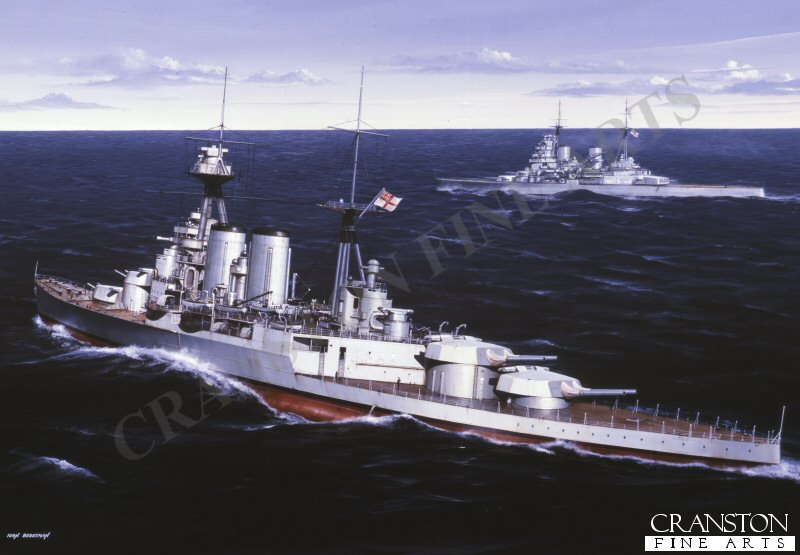
HMS Hood by Ivan Berryman (PC) Pride of the Royal Navy, the mighty Hood rolls majestically in the north Atlantic swell as HMS Prince of Wales holds station off her starboard bow. |
The Channel Dash by Ivan Berryman. (PC) February 1942 and Viz. Admiral Ciliaxs mighty Scharnhorst leads her sister Gneisenau and Prinz Eugen up the English Channel during Operation Cerberus, their daring breakout from the port of Brest on the French Atlantic coast to the relative safety of Wilhelmshaven and Brunsbuttel. All three ships survived what became known as the Channel Dash, not without damage, but the operation proved a huge propaganda success for Germany and a crushing embarrassment for the British. A number of torpedo boats are in attendance, including Kondor and Falke and the Z class destroyer Friedrich Ihn in the distance. |
HMS King George V by Ivan Berryman (PC) HMS King George V, commissioned in 1940, was lead ship of five King George V-class battleships. It would take part in all three naval theatres during World War Two, also joining in on the hunt for and sinking of the Bismarck.. After the war it became a training battleship in 1947 and was decommissioned in 1949. Additional colour added to enhance this previously black and white image. |
SMS Derfflinger by Ivan Berryman. (PC) No text for this item |
The Bee Goes to War by Ivan Berryman. (PC) In May, 1940, Operation Dynamo was initiated to rescue British and French forces from the beaches of Dunkirk. As well as the Royal Navy and Royal Air Force, over 800 small ships crossed the English Channel to help with the evacuation. Among them was the MV Bee, registered at Cowes and, at 7.30pm, she and her four crew set off from Ramsgate for the French coast. Bravely crewed by Bill Trowbridge, Harry Downer; Mark Hocking and Fred Reynard, the Bee rescued over 400 men under constant attack from the German Luftwaffe, but was eventually ordered to return home having suffered propeller damage caused by submerged debris at Dunkirk. |
Moonlight Despatch by Ivan Berryman. (PC) The role of the frigate in Nelson's navy was one of the most varied of all the ships of the line, but their great speed made them ideal as communications vessels, carrying vital despatches between ships, squadrons and the Admiralty. |
|
Contact Details |
|
Sign Up To Our Newsletter!
This website is owned by Cranston Fine Arts. Torwood House, Torwoodhill Road, Rhu, Helensburgh, Scotland, G848LE Contact: Tel: (+44) (0) 1436 820269. Email: cranstonorders -at- outlook.com |
 |