|
|
|
|
|
|
|
|

|
Don't Miss Any Special Deals - Sign Up To Our Newsletter!
| ||||||||||||||||
| CLICK HERE FOR A FULL LIST OF ALL IVAN BERRYMAN PRINTS BY TITLE |
|
No.92 Sqn
Country : UK
Founded : 1st September 1917
Disbanded 1st October 1994
Codes : , GR, QJ, DL, 8L,
Aut pugna aut morere - Either fight or die
92 Squadron was formed in the First World War, as a squadron of the Royal Flying Corps, on 1st September 1917. It flew Pups, Spads and SE5s during the war, becoming an RAF squadron on the formation of the RAF on 1st April 1918, before being disbanded on 7th August 1919. On the outbreak of hostilities of World War Two, 92 Sqn reformed on 10th October 1939, flying Blenheims before converting to Spitfires. It transferred to North Africa, and for some time flew as part of 244 Wing RAF. After the war, the squadron was disbanded on 30th December 1946. On 31st January 1947, the former 91 Squadron was redesignated 92 Squadron, flying the Meteor before re-equipping with the Sabre and then the Hunter. While flying the Hunter in 1960, the squadron was designated as the RAF's aerobatic squadron, with the name Blue Diamonds, a name the squadron carried on after tranferring to the Lightning. The squadron then re-equipped with Phantoms, before being disbanded on 1st July 1991. It was reformed from a rserve squadron on 23rd September 1992, and became No.92 (Reserve) Squadron, flying the Hawk aircraft before being disbanded once more on 1st October 1994.
| Ivan Berryman No.92 Sqn Aviation Art Prints, Paintings and Drawings Aviation Art |
|
|
|
|
|
| Text for the above items : |
Where Thoroughbreds Play by Ivan Berryman. A pair of Spitfire Mk 1s of 92 Sqn, based at Pembrey, practising dogfight tactics in a rare moment of relative peace in August 1940. Nearest aircraft, N3249, (QJ-P) is that of Sgt Ralph Titch Havercroft who was to score 3 confirmed victories, 2 unconfirmed, one shared and three probables during his combat career. |
The Hunting Party by Ivan Berryman. Depicting Spitfires of No.92 Squadron, which on their first mission over Dunkirk, encountered six ME109Es and succeeded in shooting down every one of them! Such actions came to symbolise the spirit of the 92nd Squadron which went on to see intense fighting during the Battle of Britain and by the end of 1940 had claimed an astonishing 127 enemy aircraft destroyed. A dramatic and unusual perspective on this classic aeroplane addition to any collection of Spitfire paintings. |
Summer 1940 by Ivan Berryman. Pilot Officer Allan Wright - later Group Captain, and awarded DFC and AFC - pilots Spitfire QJ-S of No.92 Squadron during the Battle of Britain, with his wingman in close support. |
Duel by Ivan Berryman. With the Battle of Britain at its height and the RAF stretched to breaking point, September of 1940 was a desperate time for the young pilots who fought gallantly to defend the UK against an imminent invasion. Among those brave few was the eighteen year old Geoffrey Wellum, shown here destroying a Heinkel He.111 on 11th September in Spitfire 1a K9998. The Heinkel fought back, peppering Wellum's Spitfire with holes, but the German bomber was mortally wounded and was seen to go down in flames. |
In Them We Trust by Ivan Berryman. Two Spitfire Mk1Bs of 92 Squadron patrol the south coast from their temporary base at Ford, here passing over the Needles rocks, Isle of Wight, in the Spring of 1942. |
| Known Aces for this squadron |
| Ace Name | Victories |
| James E "Johnnie" Johnson | 36.91 |
| Robert Stanford-Tuck | 29.00 |
| Neville F Duke | 28.00 |
| Don E Kingaby | 23.00 |
| James E Rankin | 21.00 |
| James Francis Edwards | 16.50 |
| J W Villa | 15.00 |
| Allan Wright | 11.00 |
| No.92 Sqn RAF Aircraft details |
 Blenheim Manufacturer : Bristol Built : 4422 | Blenheim The Bristol Blenheim, the most plentiful aircraft in the RAFs inventory when WWII began, was designed by Frank Barnwell, and when first flown in 1936 was unique with its all metal monoplane design incorporating a retractable undercarriage, wing flaps, metal props, and supercharged engines. A typical bomb load for a Blenheim was 1,000 pounds. In the early stages of the war Blenheims were used on many daylight bombing missions. On the day that war was declared on Germany, a Blenheim piloted by Flying Officer Andrew McPherson was the first British aircraft to cross the German coast and the following morning 15 Blenheims from three squadrons set off on one of the first bombing missions The Blenheim units operated throughout the battle, often taking heavy casualties, although they were never accorded the publicity of the fighter squadrons. The Blenheim units raided German occupied airfields throughout July to December 1940, both during daylight hours and at night. Although most of these raids were unproductive, there were some successes; on 1 August five out of 12 Blenheims sent to attack Haamstede and Evere (Brussels) were able to bomb, destroying or heavily damaging three Bf 109s of II./JG 27 and apparently killing a Staffelkapitän identified as Hauptmann Albrecht von Ankum-Frank. Two other 109s were claimed by Blenheim gunners. Another successful raid on Haamstede was made by a single Blenheim on 7 August which destroyed one 109 of 4./JG 54, heavily damaged another and caused lighter damage to four more. There were also some missions which produced an almost 100% casualty rate amongst the Blenheims. One such operation was mounted on 13 August 1940 against a Luftwaffe airfield near Aalborg in north-western Denmark by 12 aircraft of 82 Squadron. One Blenheim returned early (the pilot was later charged and due to appear before a court martial, but was killed on another operation); the other 11, which reached Denmark, were shot down, five by flak and six by Bf 109s. Blenheim-equipped units had been formed to carry out long-range strategic reconnaissance missions over Germany and German-occupied territories, as well as bombing operations. In this role, the Blenheims once again proved to be too slow and vulnerable against Luftwaffe fighters and they took constant casualties While great heroism was displayed by the air crews, tremendous losses were sustained during these missions. The Blenhiem was easy pickings at altitude for German Bf-109 fighters who quickly learned to attack from below. To protect the vulnerable bellies of the Blenheims many missions were shifted to low altitude, but this increased the aircrafts exposure to anti-aircraft fire. In the German night-bombing raid on London on 18 June 1940, Blenheims accounted for five German bombers, thus proving that they were better-suited for night fighting. In July, No. 600 Squadron, by then based at RAF Manston, had some of its Mk IFs equipped with AI Mk III radar. With this radar equipment, a Blenheim from the Fighter Interception Unit (FIU) at RAF Ford achieved the first success on the night of 2–3 July 1940, accounting for a Dornier Do 17 bomber. More successes came, and before long the Blenheim proved itself invaluable as a night fighter. One Blenheim pilot, Squadron Leader Arthur Scarf, was posthumously awarded the Victoria Cross for an attack on Singora, Thailand, on 9 December 1941. Another bomber of No. 60 Squadron RAF was credited with shooting down Lt Col Tateo Katō's Nakajima Ki-43 fighter and badly damaging two others in a single engagement on 22 May 1942, over the Bay of Bengal. Katō's death was a severe blow to the Imperial Japanese Army Air Force. |
 Gladiator Manufacturer : Gloster Built : 746 | Gladiator GLOSTER GLADIATOR: A continuation form the Gloster Gauntlet aircraft the Gloster Gladiator (SS37) becoming designated the F.7/30 was named Gladiator on the 1st July 1935. The first 70 Gladiators had Under wing machine guns (Vickers or Lewis) before the browning became standard The first aircraft arrived at Tangmere airfield on in February 1937 to no. 72 squadron. at the outbreak of world war two a total of 218 Gladiators had been received by the Royal air force with a total of 76 on active service. They served also in the Middle eats and in 1940 when Italy joined the war was nearly the only front line fighter in the middle east. Between 1939 and 1941. the Gloster Gladiator flew in many war zones. flying in France, Greece, Norway, Crete Egypt Malta and Aden. The Aircraft claimed nearly 250 air victories. It stayed in front line duties until 1942, then becoming fighter trainer, and other sundry roles. It continued in these roles until the end of world war two. The Naval equivalent the Sea Gladiator a short service in the Middle east and European waters. A Total of 746 aircraft were built of these 98 were Sea Gladiators.. Performance. speed: 250mph at 17,500 feet, 257 mph at 14,600 Range 430 miles. Armament: Two fixed .3-03 browning machine guns |
 Hawk Manufacturer : BAE Systems. Built : 1050 | Hawk The BAe Hawk News of the first flight of the Hawk on 21 August 1974 was greeted with derision by Hunter pilots at the RAF's tactical weapons training unit. For understandably selfish reasons they were sceptical about the ability of the Hawk to replace the rugged, versatile and much-loved Hunter. "Forget Hawk - Fly Hunter" was one typical bumper sticker of the time but now 25 years on, such scepticism seems barely credible. With the arrival of the first Hawk aircraft at RAF Valley in November 1976, a new era of flying training began, and the first of thousands of fast-jet pilots discovered the joys of flying this truly thoroughbred aircraft. Since then, the BAe Hawk has earned a reputation as the world's best advanced trainer and light strike aircraft. The basic design has been refined and improved in a series of variants ranging from multi-role light fighter to the US Navy's carrier trainer. But the one quality that sets the Hawk apart from other aircraft is handling characteristics. In the on pilots own words, - "I had flown the Gnat and Hunter and in 1979 had just finished flying Canberra PR9s before transferring to the Jaguar, when I was given the opportunity to get some flying on the Hawk. It was a revelation. Here was an aircraft that was pure joy to fly, at low level it settled comfortably at 450 knots at around 150 feet and it could be flown into valleys under the most frightening weather safe in the knowledge that it could be turned around without losing airspeed almost in its own length. And at medium level? 1v1 combat in this aircraft is something else, - compared with the Hawk, the Jaguar is like flying an anvil". |
 Hunter Manufacturer : Hawker Built : 1972 | Hunter Hawker Hunter F-1 to Fr-10 jet fighter and fighter reconnaissance aircraft first flew with No43 squadron Royal Air Force in July 1954. The Hawker Hunter continued service until 1971. The Hunters were used by two RAF display units, the "Black Arrows" of No. 111 Squadron who set a record by looping and barrel rolling in formation 22 Hunters, and later the "Blue Diamonds" of 92 Squadron that used 16 Hunters. A total of 1,972 Hunters were produced by Hawker Siddeley and under licence. |
 Hurricane Manufacturer : Hawker Built : 14533 | Hurricane Royal Air Force Fighter, the Hawker Hurricane had a top speed of 320mph, at 18,200 feet and 340mph at 17,500, ceiling of 34,200 and a range of 935 miles. The Hurricane was armed with eight fixed wing mounted .303 browning machine guns in the Mark I and twelve .303 browning's in the MKIIB in the Hurricane MKIIC it had four 20mm cannon. All time classic fighter the Hurricane was designed in 1933-1934, the first prototype flew in June 1936 and a contract for 600 for the Royal Air Force was placed. The first production model flew ion the 12th October 1937 and 111 squadron of the Royal Air Force received the first Hurricanes in January 1938. By the outbreak of World war two the Royal Air Force had 18 operational squadrons of Hurricanes. During the Battle of Britain a total of 1715 Hurricanes took part, (which was more than the rest of the aircraft of the Royal air force put together) and almost 75% of the Victories during the Battle of Britain went to hurricane pilots. The Hawker Hurricane was used in all theatres during World war two, and in many roles. in total 14,533 Hurricanes were built. |
 Lightning (RAF) Manufacturer : BAC Built : 278 | Lightning (RAF) English Electric (later BAC) Lightning. Originally designed by W F Petter (the designer of the Canberra) The first Lighting Prototype was first flown on the 4th August 1954 by Wing Commander R P Beamont at Boscombe Down. The second prototype P1A, The name of Lightning was not used until 1958) (WG763) was shown at the Farnborough show in September 1955. The Third prototype was flown in April 1957 and was the first British aircraft ever to fly at Mach 2 on the 25th November 1958 The first production aircraft made its first flight on 3rd November 1959 and entered operational service with the RAF on the 29th June 1960with |NO. 74 squadron based at Coltishall. The F1 was followed shortly after by the F1A which had been modified to carry a in-flight refueling probe. The Lightning F2 entered service in December 1962 with no 19 and 92 squadrons. a total of 44 aircraft F2 were built. The F3 came into service between 1964 and 1966 with Fighter Command squadrons, re engined with the Roll's Royce Avon 301 turbojets. The Lightning T Mk 5 was a training version Lightning a total of 22 were built between August 1964 and December 1966. The BAC Lighting F MK 6 was the last variant of the lightning, base don the F3, this was the last single seat fighter and served the |Royal Air Force for 20 years. First Flown on 17th April 1964, and a total of 55 F6 saw service with the Royal Air Force, and the last Lightning F6 was produced in August 1967. A Total of 278 lightning's of all marks were delivered. In 1974 the Phantom aircraft began replacing the aging Lightning's, but 2 F6 remained in service up to 1988 with Strike Command until finally being replaced with Tornado's. Specifications for MK1 to 4: Made by English Electrc Aviation Ltd at Preston and Samlesbury Lancashire, designated P1B, All Weather single seat Fighter. Max Speed: Mach 2.1 (1390 mph) at 36,000 feet Ceiling 55,000 feet Armament: Two 30mm Aden guns and Two Firestreak infra red AAM's. Specificaitons for MK 6: Made by English Electrc Aviation Ltd at Preston Lancashire, designated P1B, All Weather single seat Fighter. Max Speed: Mach 2.27 (1500 mph) at 40,000 feet Ceiling 55,000 feet Range: 800 miles. Armament: Two 30mm Aden guns and Two Firestreak infra red AAM's. or Two Red Top. or two retractable contain 24 spin-stabilized rockets each. |
 Meteor Manufacturer : Gloster Built : 3947 | Meteor The Gloster Meteor was the first British jet fighter and the Allies' first operational jet. Designed by George Carter, and built by the Gloster Aircraft Company, Armstrong-Whitworth, the Meteor first flew in 1943 and commenced operations on 27 July 1944 with 616 Squadron of the Royal Air Force (RAF). The Gloster Meteor was not an aerodynamically advanced aircraft but the Gloster design team succeeded in producing an effective jet fighter that served the RAF and other air forces for decades. Meteors saw action with the Royal Australian Air Force (RAAF) in the Korean War and other air forces used the Meteor. The Royal Danish Air Force, The Belgian Air Force and Isreali Air Force kept the Meteor in service until the early 1970's. A Total of 3947 meteors were built and two Meteors, WL419 and WA638, remain in service with the Martin-Baker company as ejection seat testbeds. |
 SE5a | SE5a The third S.E.5 produced (A4563) became, in effect, the prototype S.E.5a with a 200hp Hispano Suiza power plant and shorter span wings. The S.E.5.a went to No56, No.40 and No.60 squadrons from June 1917, and by the end of the year No's 24, 41, 68 and 84 squadron had taken them on charge. After troubles with the reduction gear of the Hispano Suiza together with a general shortage of these power plants, the direct drive Wolseley Viper became the standard S.E.5a power unit. The S.E.5.a built a fine reputation for strength, performance and general flying quality, which together with the Sopwith Camel was the main reason for the Allies gaining and maintaining air superiority during 1918. Some aircraft were fitted with four 25lb (11kg) Cooper bombs on under fuselage racks. The S.E.5.a also service in the Middle East and several home defence units in 1918. At the end of World War I over 2,000 S.E.5.a aircraft were in service with the RAF. The type had served with 24 British, 2 US and 1 Australian Squadrons. After its 'demob' 50 of these aircraft were supplied to Australia, 12 to Canada with several more to other countries including South Africa, Poland and the United States of America. 50 came onto the British register and were used for developing the art of sky-writing. The S.E.5.a will always remain one of aviation's great warplanes. |
 Sopwith Pup Manufacturer : Sopwith Built : 1770 | Sopwith Pup The Sopwith Pup was a single-bay, single-seat biplane aircraft with a fabric-covered, wooden framework and staggered, equal-span wings. The prototype and most production Pups were powered by the 80 hp (60 kW) Le Rhone engine and armed with a single 0.303 inch (7.7 mm) Vickers machine gun which was synchronized with the Sopwith - Kauper synchronizer. The first Sopwth Pup prototype was completed in February 1916 with flight tests in late March. The Royal Naval Air Service (RNAS) were impressed and ordered two more prototypes, then placed a production order. Deliveries of the Pups started in August 1916. The Royal Flying Corps (RFC) also placed large orders for Pups. The RFC orders were built by Standard Motor Co and Whitehead Aircraft who had both been sub-contracted. Deliveries did not commence until the beginning of 1917. The Sopwith Pup was eventually outclassed by newer German fighters, but some continued in service on the Western Front until the end of 1917. The remaining Sopwith Pups were used for Home Defence and training units. The Pup's docile flying characteristics also made it ideal for use in Aircraft Carrier Carrier deck landing and takeoff experiments and many were used on Royal Navy Battleships. A total of 1,770 Pups were built by Sopwith (96), Standard Motor Co (850), Whitehead Aircraft (820), and Willaim Beardmore and co building 30 aircraft |
Spad | Spad No profile available |
 Spitfire Manufacturer : Supermarine Built : 20351 | Spitfire Royal Air Force fighter aircraft, maximum speed for mark I Supermarine Spitfire, 362mph up to The Seafire 47 with a top speed of 452mph. maximum ceiling for Mk I 34,000feet up to 44,500 for the mark XIV. Maximum range for MK I 575 miles . up to 1475 miles for the Seafire 47. Armament for the various Marks of Spitfire. for MK I, and II . eight fixed .303 browning Machine guns, for MKs V-IX and XVI two 20mm Hispano cannons and four .303 browning machine guns. and on later Marks, six to eight Rockets under the wings or a maximum bomb load of 1,000 lbs. Designed by R J Mitchell, The proto type Spitfire first flew on the 5th March 1936. and entered service with the Royal Air Force in August 1938, with 19 squadron based and RAF Duxford. by the outbreak of World war two, there were twelve squadrons with a total of 187 spitfires, with another 83 in store. Between 1939 and 1945, a large variety of modifications and developments produced a variety of MK,s from I to XVI. The mark II came into service in late 1940, and in March 1941, the Mk,V came into service. To counter the Improvements in fighters of the Luftwaffe especially the FW190, the MK,XII was introduced with its Griffin engine. The Fleet Air Arm used the Mk,I and II and were named Seafires. By the end of production in 1948 a total of 20,351 spitfires had been made and 2408 Seafires. The most produced variant was the Spitfire Mark V, with a total of 6479 spitfires produced. The Royal Air Force kept Spitfires in front line use until April 1954. |
| No.92 Sqn RAF Pilot and aircrew signature details |
  Squadron Leader Neville Duke, DSO, OBE, DFC*, AFC, CzMC Our estimated value of this signature : £75 Died : 2007 | Squadron Leader Neville Duke, DSO, OBE, DFC*, AFC, CzMC Neville Duke flew Spitfires as wingman to Sailor Malan in 92 Squadron. In November 1941 he was posted to 112 Squadron in the Middle East. After a second tour in the Desert, he flew a third tour, with 145 Squadron in Italy. He was the top scoring Allied Ace in the Mediterranean with 28 victories. After the war, in 1953, he captured the World Air Speed record. He died 7th April 2007. |
  Air Vice Marshal Johnnie Johnson CB, CBE, DSO**, DFC* Our estimated value of this signature : £70 Died : 2001 | Air Vice Marshal Johnnie Johnson CB, CBE, DSO**, DFC* James Edgar Johnson was born in Barrow on Soar near Loughborough on 9th March 1915. He lived in Melton, the first house on the left of Welby Lane as you leave Nottingham Road, with his parents - his father being a local Police Inspector. Johnnie qualified as a Civil Engineer at Nottingham University in 1937. He joined the RAFVR and did his flying training at 21 E&RFTS, Stapleford before enlisting for full-time service in the RAF at the beginning of WWII. He first went to ITW at Jesus College, Cambridge, completed his ab initio flying at 22 EFTS, Cambridge and his intermediate and advanced flying at 5 FTS, Sealand. Johnnie Johnson joined 92 Spitfire squadron in August 1940, but it was with 616 squadron that he scored his first victory on June 26th 1941 while flying with Douglas Baders Tangmere Wing. He was squadron leader of 610 squadron in July 1942, but it was as Wing Commander of the Kenley Wing in 1943 that his scores really started to mount. He was W/C of 144 wing during D-Day and led 127 and 125 wings until the end of the war when we has the topscoring allied fighter pilot with 38 air victories. Inspired by the great British WW 1 aces like Bishop and Ball, Johnnie Johnson dreamed often as a child of becoming an R.A.F. pilot. The young Johnson enthusiastically joined the Volunteer Reserve at the first opportunity. After completing his initial flight training Johnson was posted to 616 Squadron at Kenley. However, this Squadron had been hit hard with the loss of six pilots and five wounded, and the unit was withdrawn to Coltishall prior to Johnson encountering combat. With only 12 hours of flight time in a Spitfire this was no doubt advantageous. In February 1941 Billy Burton moved the Squadron to Tangmere. Douglas Bader then arrived to take over the Tangmere Wing, and fly with the 616 Squadron. Johnnie, Alan Smith and Cocky Dundas were chosen to fly with Bader. During the summer of 1940 the Battle of Britain was at its peak. Bader took the time to instruct Johnson carefully in both the art of flying and the skills necessary to attain success in aerial combat. Baders idea of an afternoon off duty, according to Johnson, was to take his section over the Channel in hopes of running into Adolph Galland and his Abbeyville Boys. On August 19, 1941 Bader failed to return from a mission when 616 Squadron was hit hard by a group of Messerschmitt 109s. Johnson flew on in Baders absence, and in the summer of 1942 he was promoted to command of the 610 Squadron. In 1943 he was promoted again to Wing Commander of the Canadian Spitfire Wing in Kenley. By that time Johnson had attained eight confirmed victories. During the spring and summer of 1943 Johnnie led the Canadian unit on more than 140 missions over Northwest Europe. Johnsons squadron attained more than 100 victories during this period, and Johnnies own personal score rose to 25. After a short leave, Johnson was posted to lead the 144 Canadian Spitfire Wing. On D-Day Johnson led his Wing on four missions in support of the Allied invasion. On June 8, Johnsons Wing was the first Spitfire group to land in newly liberated France. Johnson continued fighting in France through September 1944 when he achieved his 38th and final victory. Patrolling the Rhine Johnsons unit jumped nine 109s which were flying beneath them in the opposite direction. Five of the 109s were downed. Early in 1945 Johnson was promoted to Group Captain and put in command of the 125 Wing, which was equipped with the Spitfire XIV. Flying from former Luftwaffe airfields the 125 Wing assisted in the final Allied push to Berlin. Johnson attributed much of his aerial combat success to his ability to make tight turning maneuvers. Johnsons tightest call came on August 19, 1942 when he was unable to dislodge an Me-109 from his tail during the raid on Diepppe. Johnson raced his Spitfire flat out at a group of Royal Navy ships. The usual barrage of flak and tracer fire came right at him, and fortunately for the ace, missed his Spitfire but effectively eliminated the brave pilot on his tail. During the Korean War Johnson flew fighter-bombers with the USAF. Following his retirement from the R.A.F. in 1966 Johnson founded the Johnnie Johnson Housing Trust that has provided homes for more than 4000 disabled and elderly persons, and his sixth book Winged Victory was published in 1995. Johnson flew many of the Spitfire models. His favorite was the beautiful Mark IX, the best of them all. Johnnie passed away in 2001 at the age of 85, in Derbyshire, England. |
Group Captain Brian Kingcome DSO DFC Our estimated value of this signature : £65 Died : 1994 | Group Captain Brian Kingcome DSO DFC Brian Fabris Kingcome was born in Calcutta on May 31st 1917. Brian Kingcome was educated at Bedford and in 1936 entered the RAF College, Cranwell. Soon after he began his pilot course he was seriously injured in a car accident and was told by the RAF medical board that he would never fly again as he was expected to suffer permanent double vision. But after months in hospital and with Brians strength of character he proved the board wrong. In 1938 he was posted to No 65, a biplane Gladiator fighter squadron based at Hornchurch. Brian Kingcome took part in the Battles of France and Dunkirk but transferred to 92 Squadron as a flight commander and flying Spitfires in May 1940 scoring his first victories in June 1940. Brian Kingcome became acting commanding officer during the latter stages of the Battle of Britain. During this time he and his pilots achieved the highest success rate of any squadron in the entire Battle of Britain. After being shot down by Me109s and wounded, he returned to active operations. In February 1942 he was posted to command 72 Squadron, followed by promotion to Wing Leader at Kenley. In May 1943 he was posted to lead 244 Wing in the Mediterranean during the invasion of Sicily. An Ace, Brian Kingcome flew Spitfires in combat continually until the end of 1944, his tally finishing at 8 and 3 shared destroyed, plus a score of probables and damaged. One of the prewar Cranwell elite, Brian Kingcome was to become one ofthe Second World Wars great fighter leaders, alongside such immortals as Douglas Bader, Bob Stanford Tuck and Johnnie Johnson. At the outbreak of war he was serving in 65 Squadron, but in May 1940 was posted to 92 Squadron as flight commander. On 25 May he shared a Do 17 and on 2 June destroyed two He l l Is and damaged a third. He shared a Ju 88 with two others on I0 July, and again on the 24th. On 9 September he probably destroyed a Bf 110 and two days later shot down a He 111. On the 14th he damaged another. He shot down a Bf 109 on the 23rd and next day probably destroyed another and damaged a Ju 88. Three days later he shared a Ju 88 again, damaged two others, probably destroyed a Do 17, and damaged one of these also. Around this time he was awarded a DFC for six victories, and on 11 October got a Bf 109 He claimed another next day, and also damaged one. In 1941 he became commanding officer, having frequently led the squadron. It will be noted that he claimed many probables and damaged during the Battle of Britain, and this was due to his view that it was more important to hit as many as possible than to try and confirm victories. On 16 June 1941 lie probably destroyed a Bf 109, and on 24 July shot one down. He was then rested until late in the year, when he was posted to command 72 Squadron, and in February 1942 gave escort cover to the Fleet Air Arm pilot Eugene Esmonde, who won the VC trying to attack German capital ships Scharnhorst and Gneisenau and and the cruiser Prinz Eugen with Swordfish during the Channel Dash. In atrocious weather Kingcome caught a fleeting glimpse of tbe Scharnhorst - Oh what a beautiful battleboat! he exclaimed, just as a shell made a hole the size of a dustbin lid in his port wing. During 1941 he received a Bar to his DFC, having brought his score to 10. He was promoted to lead the Kenley wing, and on 15 April 1942 damaged a Fw 190. He probably destroyed a Bf 109 on 28 May, and during the year was awarded a DSO, having added another victory to his score. In 1943 he was posted to North Africa to lead 244 Wing, and lead this for 18 months, becoming a Gp. Capt. after the invasion of Italy. By the end of his stay with the wing he had brought his score to 18, and was then posted as SASO of a Liberator group, and flew an operation as a waist gunner over northern Yugoslavia after taking up this appointment. Sadly Group Captain Brian Kingcome passed away aged 76 in 1994. |
 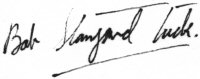 Wing Commander Bob Stanford Tuck DSO DFC** Our estimated value of this signature : £85 Died : 1987 | Wing Commander Bob Stanford Tuck DSO DFC** Bob Stanford Tuck was a flamboyant fighter pilot, his dashing good looks, courage, and success in the air coming to epitomise the young flyers who fought and won the Battle of Britain. To the British public he was a hero in the mould of the knights of old, and today his name is legend. In the early stages of the Battle of Britain Bob fought with 92 Squadron flying Spitfires, quickly becoming one of the leading aces. Promoted to command 257 Squadron, now flying Hurricanes, Bobs dashing style of leadership inspired his pilots to great success. He went on to command the Duxford and Biggin Hill Wings, taking his personal score to 29 air victories before being shot down by ground fire over Northern France in 1942. He died on 5th May 1987. |
  Squadron Leader Geoffrey Wellum DFC Our estimated value of this signature : £55 Died : 2018 | Squadron Leader Geoffrey Wellum DFC Joined the RAF with a Short Service Commission in August 1939. He joined 92 Squadron flying Spitfires in June 1940 at the time of Dunkirk. He flew throughout the Battle of Britain, later completing over 50 fighter sweeps and escorts over northern France and Belgium until August 1941. He then joined 65 Squadron as Flight Commander in March 1942 operating over northern France and flew off aircraft carrier HMS Furious on Operation Pedestal, to Malta. Geoff was a Flight Lieutenant during Operation Pedestal. He returned to the UK as a test pilot for Gloster Aircraft and finished the war as a Pilot Attack Instructor. Geoffrey was credited with three destroyed, four probables and several damaged and was awarded the DFC in July 1941. Geoffrey Wellum died on 18th July 2018. |
|
Contact Details |
|
Sign Up To Our Newsletter!
This website is owned by Cranston Fine Arts. Torwood House, Torwoodhill Road, Rhu, Helensburgh, Scotland, G848LE Contact: Tel: (+44) (0) 1436 820269. Email: cranstonorders -at- outlook.com |
 |


