|
|
|
|
|
|
|
|

|
Don't Miss Any Special Deals - Sign Up To Our Newsletter!
| ||||||||||||||||
| CLICK HERE FOR A FULL LIST OF ALL IVAN BERRYMAN PRINTS BY TITLE |
|
Ivan Berryman Art  Postcards Postcards |
[UP] - Aviation Art - Royal Navy - US Navy - German Navy - French Navy - Italian Navy - Spanish Navy - Maritime Art - Nelson's Battles - Motor Racing - Railways and Steam - Original Acrylic Paintings - Star Wars Art - Postcards - Paintings in Progress |
| More Pages : Aviation Postcards - Naval Postcards |
| Navigation | |
| Page 2 of 38 | Previous .. Page 2 .. Next |
|
|
|
|
|
|
|
|
|
|
|
|
|
|
|
|
|
|
|
|
|
| Navigation | |
| Page 2 of 38 | Previous .. Page 2 .. Next |
| Text for the above items : |
Warm Work by Ivan Berryman. (PC) The time is approximately 12.20pm on 21st October 1805. HMS Victory forces her way through the combined Spanish and French line, firing all her larboard guns into the stern of Admiral Villeneuve’s flagship. Bucentaure was utterly destroyed by the initial salvo with twenty of her guns smashed off their mounts and over 300 of her crew left dead or disabled. But Victory herself had suffered much during the perilous approach to the enemy fleet. Unable to bring any guns to bear, she received multiple hits from the Franco-Spanish ships, bringing down her mizzen top, her fore topgallant mast, her studding sails and smashing the ship’s wheel. The bowsprit, part of her figurehead and catheads were shattered, her anchors carried away and the entire bow, headrails and beakhead were peppered with shot. The title of the painting refers to a comment made by Admiral Horatio Nelson as HMS Victory began to receive fire from the enemy. A piece of hot shrapnel tore the buckle off Nelson’s shoe as he paced the deck with Captain Hardy, to which he responded, “It is warm work today!” Sadly, just one hour later, Nelson was fatally wounded by a sharpshooter stationed on the mizzen top of the French Redoutable which can be seen to the left of the painting. The towering spectre of HMS Temeraire looms in the gunsmoke as she follows HMS Victory into the fray |
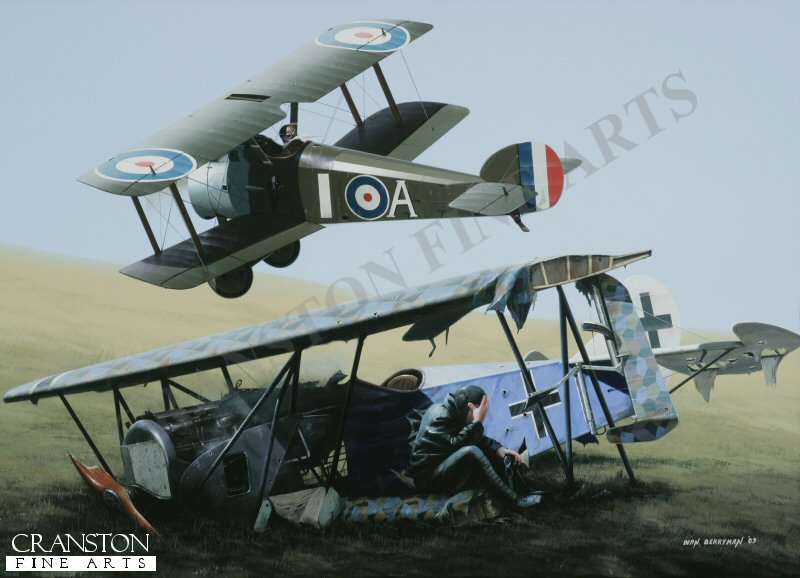
Captain Arthur Henry Cobby by Ivan Berryman. (PC) Arriving in France in 1917 with little or no air gunnery training behind him, Captain Arthur Harry Cobby went on to become the Australian Flying Corps highest scoring ace with 29 victories to his credit, five of them observation balloons. He is shown here in Sopwith Camel E1416 of 4 Sqn AFC (formerly 71 Sqn AFC) having downed one of his final victims, a Fokker D.VII on 4th September 1918. Cobby survived the Great War and served in the RAAF during the inter war period and World War Two, eventually leaving the service as Air Commodore CBE. He died in 1955. |
HMS Royal Oak by Ivan Berryman (PC) The R-class battleship Royal Oak lies at anchor in Scapa Flow between the wars ahead of her sisters Royal Sovereign and Revenge. HMS Repulse is passing the line on the left of the picture. Additional colour added to enhance this previously black and white image. |
HMS Illustrious and HMS Kenya at Devonport by Ivan Berryman. (PC) HMS Illustrious slips quietly away from the docks at Devonport, Plymouth with the Fiji class cruiser in the middle distance, 1941. |
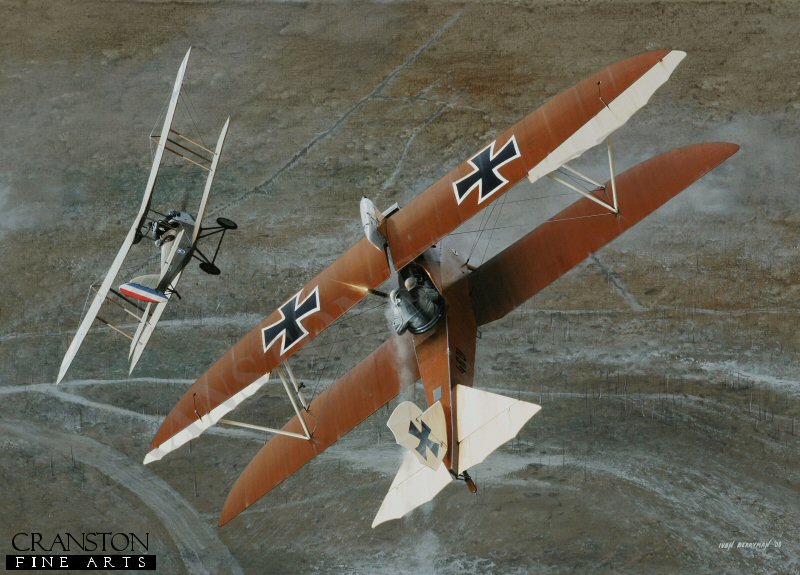
Josef Kiss by Ivan Berryman. (PC) Flying from Pergine airfield in Northern Italy some time in March 1918, Offz Stv Josef Kiss is depicted on patrol over the Piave in Albatros DIII (Oef) 153.186, his aircraft carrying the personalised 'medal' decoration overpainted with a white 'K'. Below him is the similar aircraft of Oblt Josef von Maier, also of Flik 55/J. Kiss was to attain a victory score of 19 aircraft destroyed before being killed in combat on 24th May 1918. |
Outnumbered by Ivan Berryman. (PC) On 1st February 1918, the great Austro-Hungarian ace Godwin von Brumowski found himself abandoned by his wingmen and left to fight off eight Sopwith Camels of 45 Sqn RFC single handed. On this occasion, it was he that came off the worst, managing to nurse his badly damaged Albatros D.III (Oef) 153.45 back to base, the aircraft becoming engulfed in flames at some point, probably due to a hit in the fuel tank. The fuselage of his machine was riddled with 26 bullet holes and the fabric of the wings was punctured and shredded, but he continued the fight until his guns jammed and he was forced to break away. Undaunted, the Ace was back in the air the next day, only to have these dreadful events repeat themselves just three days later, Brumowski again nursing his shattered aircraft home. |
HMS Victory by Ivan Berryman. (PC) Arguably the best known warship in the world, and one of only a few survivors of her era, HMS Victory was the flagship of Admiral Lord Horatio Nelson at Trafalgar in 1805, leading the victorious British fleet into battle against the combined French and Spanish navies. Severely damaged during the battle, she remained afloat at Portsmouth into the 20th century and is now preserved there in dry dock for future generations to visit. Extraordinarily, HMS Victory is still a commissioned ship in the Royal Navy and is frequently used for ceremonial duties. |
Tribute to Walter Briegleb by Ivan Berryman. (PC) Walter Briegleb is shown in his Ju88 G.7 4R+BR as he stalks his prey - on this occasion a Lancaster. Flying below their target, his crew would aim upward firing cannon at the inner wing of the bomber, igniting the fuel tanks. For the bomber crews, they were very much defenceless against this type of attack, and often had no idea of the presence of an enemy aircraft in the dark. |
Lloyd C.V by Ivan Berryman. (PC) The Austro-Hungarian Lloyd C.V was a two-seat observation aircraft which was unconventional both in appearance and construction. Its unusually-shaped wings were not fabric covered, but were laminated in plywood for strength and lightness. This innovation, however, caused great problems with maintenance, battle damage repair and structural fatigue caused by moisture building up inside the wing section. Despite its faults, the C.V was a fast and streamlined machine that acquitted itself well during its brief career, 144 of the type being produced by the Lloyd and WKF factories in 1917. |
Anton Hafner by Ivan Berryman. (PC) The top scoring ace of JG.51, Anton Hafner is credited with 204 confirmed victories. A prolific scorer, on 8th August 1944, he shot down no fewer than seven Russian Sturmoviks and, by October of that year, his overall tally had exceeded 200. He died in combat with a Yak 7, his 204th victim, when his aircraft hit a tree. He is shown here in Messerschmitt Bf.109G-6 442013 Black 1. |
Tribute to Sottotenente Giuseppe Biron by Ivan Berryman. (PC) Giuseppe Biron was one of Italy's most successful pilots serving on the Eastern Front in 1941, claiming at least four kills against Russian aircraft, as depicted here, as he sends a Mig 3 down in flames whilst flying a Macchi MC.200 with 369a Squadriglia, 22° Gruppo Autonomo. Biron's aircraft sports the scarecrow smoking red stars emblem, designed by Biron himself and adopted as 22° Gruppo's badge before their deployment to the USSR. |
HMS Dido by Ivan Berryman. (PC) HMS Dido was launched on 18th July 1939, she took part in the evacuation of troops and defense of Crete, where she was damaged on B gun, killing 46 men. HMS Dido took part in the second Battle of Sirte during 1942, she sank three supply ships off North Africa. She also took part in the Anzio landings and the invasion of Southern France in August 1944. |
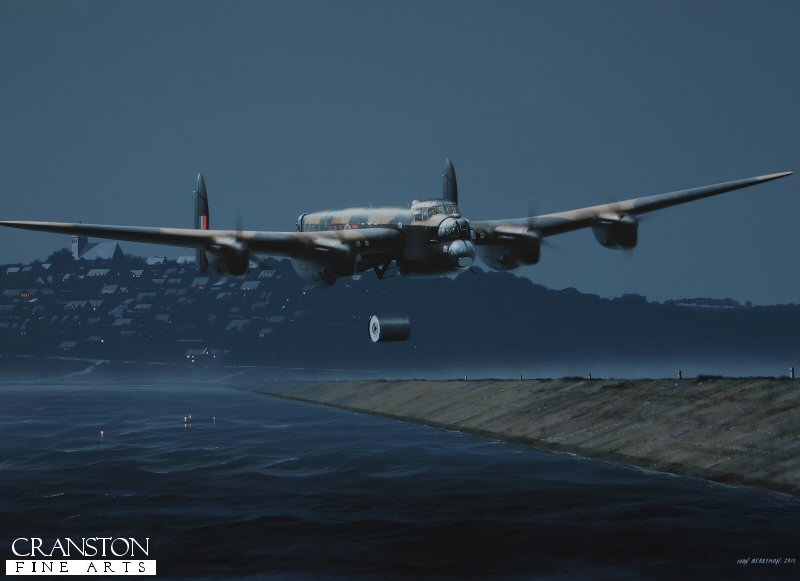
Attack on the Sorpe by Ivan Berryman. (PC) Of the five Lancasters that formed the Second Wave of Operation Chastise, just one aircraft made it to the target, the Sorpe Dam, on the night of 16th/17th May 1943. American pilot Joe McCarthy had been forced to switch to the reserve aircraft due to technical difficulties and subsequently took off slightly later than his less fortunate comrades, all of whom fell either to German flak or to mishaps on their perilous journey. Upon arrival, McCarthy found the view of the dam itself to be unobscured, although mist in the surrounding valleys made it difficult to gauge his approach. As this was not a masonry dam, a different tactic was employed to the Möhne and Eder which involved flying along the length of the dam and dropping the Upkeep bomb, unspun, directly onto it. Their task was made all the more difficult by the fact that their approach necessitated McCarthy bringing AJ-T low over the hilltop village of Langsheid whose Church spire occupied the very point at which the aircraft had to pass to get a good run upon the dam. Undaunted and with great skill, ED825(G) made its run and released the bomb onto the dam, unassisted by the spotlight altimeter device that had proved so useful at the Möhne and Eder as AJ-T had not been fitted with this aid. Nevertheless, the Upkeep struck the dam and exploded as planned, sadly with little effect. McCarthy and his brave crew returned safely to Scampton, their landing made slightly difficult by a tyre that had been damaged by light flak on the return journey. The Sorpe was attacked again in the small hours of the morning when Flight Sergeant Ken Brown's aircraft, AJ-F of the Third Wave arrived, once more striking the dam successfully, but again without breaching it. |
Spitfire Mk.IXE by Ivan Berryman. (PC) A pair of Spitfire Mk.IXEs of 611 Squadron make their way home from a patrol during the summer of 1942. At this time 611 Squadron were based at Kenley and were the first squadron to receive the new Mk.IX putting it on equal terms, for the first time, with the formidable Focke-Wulf 190. |
Tribute to Leonard H Rochford by Ivan Berryman. (PC) Recording 18 individual victories plus another 11 shared with other pilots, Leonard 'Tich' Rochford scored most of his victories in the Sopwith Camel. However, under the stewardship of the more experienced Raymond Collishaw - who became the second highest scoring Candian Ace of the war - he flew his early missions with No.3 Naval Air Squadron in the Sopwith Pup. He had forced two Albatros down out of control in March and May 1917 before the victory depicted here on 7th July 1917. In Sopwith Pup N6162 he shared in the destruction of an enemy seaplane with 4 other pilots north of Ostend. He is one of the top 30 Commonwealth Aces of the war, and was awarded the Distinguished Flying Cross and Distinguished Service Cross with Bar. He died in 1986 aged 90. |
Tribute to the Lockheed C-130 Hercules by Ivan Berryman. (PC) Entering service as far back as 1956, the C-130 Hercules is the longest continuously produced military aircraft and has served with many countries throughout the world. This versatile aircraft has been a military transport, firefighting aircraft, missile platform and humanitarian supply aircraft in a multitude of roles. Among its notable achievements is a record set in 1963 for the largest and heaviest aircraft to land on an aircraft carrier. |
Tribute to Maggiore Francesco Baracca by Ivan Berryman. (PC) Francesco Baracca was Italy's highest-scoring ace in World War 1, his victory tally being an impressive 34 at the time of his death. His Spad S.VII carried his personal emblem, the Prancing Horse, a tribute to his days in the cavalry. Upon his death in this aircraft on 19th June 1918, Baracca's mother donated the emblem to Enzo Ferrari whose cars still carry this badge the world over. He is depicted here despatching the Oefag-built Albatros of Rudolf Szepessy-Sokell of Flik 41J on 6th November 1917. |
Victory near Podgorica by Ivan Berryman. (PC) As the invading forces took hold in Italy, many Italian pilots transferred their allegiance to the Aeronautica Co-Beligerante, among them Maggiore Teresio Martinoli who was to become Italy's highest scoring ace with 22 victories, before being tragically killed in a training accident. He is depicted here claiming a Ju.52 in the skies of Yugoslavia whilst flying the exceptional Macchi MC.205 Veltro. |
QRA Scramble by Ivan Berryman. (PC) A pair of 29 Squadron Lightning F.Mk3s tuck their gear up and head skyward from the Wattisham tarmac in the summer of 1972. |
Prowler's Return by Ivan Berryman. (PC) Rocket rails empty, Mosquito FB.VI RS619 (LA-F) of 235 Sqn races home low and fast after another successful anti-shipping strike in the Fjords of Norway. On a subsequent mission on 5th April 1945, this aircraft crash-landed in Denmark after suffering a glycol leak. Its crew, Ray Harrington and Bert Winwood, managed to get back home to the UK with the help of the Danish Resistance. |
Tribute to Frank Carey by Ivan Berryman. (PC) Frank Carey, depicted here in his Hurricane of No.43 Squadron, was one of Britain's top Aces of the war. He scored over 20 confirmed victories as well as several shared or probable claims - these were in Europe during the Battle of France and Battle of Britain, but also later in the war in the east against the Japanese during their invasion of Burma. He was awarded a CBE in addition to his Distinguished Flying Cross with two bars, Distinguished Flying Medal and Air Force Cross. |
|
Contact Details |
|
Sign Up To Our Newsletter!
This website is owned by Cranston Fine Arts. Torwood House, Torwoodhill Road, Rhu, Helensburgh, Scotland, G848LE Contact: Tel: (+44) (0) 1436 820269. Email: cranstonorders -at- outlook.com |
 |