|
|
|
|
|
|
|
|

|
Don't Miss Any Special Deals - Sign Up To Our Newsletter!
| ||||||||||||||||
| CLICK HERE FOR A FULL LIST OF ALL IVAN BERRYMAN PRINTS BY TITLE |
|
Ivan Berryman Art  Aviation Art Royal Air Force Aviation Art Royal Air Force  Hurricane Hurricane |
[UP] - Spitfire - Hurricane - Mosquito - Beaufighter - Lancaster - Halifax - Wellington - Stirling - Vulcan - Blenheim - Anson - Battle - Sunderland - Lightning - Typhoon - More Aircraft - Red Arrows - The Shuttleworth Collection - RAF Print List |
| Ivan Berryman Hurricane Aviation Art Prints, Paintings and Drawings Aviation Art |
| Navigation | |
| Page 1 of 2 | Page 1 .. Next |
|
|
|
|
|
|
|
|
|
|
|
|
|
|
|
|
|
|
|
|
|
| Navigation | |
| Page 1 of 2 | Page 1 .. Next |
| Text for the above items : |
Ground Force by Ivan Berryman. Routine, though essential, maintenance is carried out on a 501 Sqn Hurricane at the height of the Battle of Britain during the Summer of 1940. Hurricane P3059 SD-N in the background is the aircraft of Group Captain Byron Duckenfield. |
Close Combat by Ivan Berryman. Whilst flying with A Flight of 85 Squadron on 30th July 1940, Geoffrey Allard encountered a pair of Messerschmitt Bf.110s about 40 miles from the coast, apparently patrolling near a convoy. After Squadron Leader Townsend, flying Red 1, had made two unsuccessful attacks, Allard closed to 150 yards and began to fire continuously, eventually closing to just 25 yards, whereupon the starboard engine of the Bf.110 began to disintegrate. This was just one of eight victories that Allard claimed during the Battle of Britain to add to a previous eight that he had scored flying Hurricanes during the Battle of France. |
Tribute to Flt Lt Ian R Gleed by Ivan Berryman. Flight Lieutenant Ian Widge Gleed is depicted in his personal Hurricane 1 P2798 (LK-A) of 87 Sqn shooting down a Messerschmitt Bf.110 on 15th August 1940. Just visible beneath the cockpit of the Hurricane is his mascot, Figaro, shown kicking a swastika. His aircraft was also easily identifiable by the red flash on its nose, a feature that was retained even when P2798 was painted all black for its night fighter role. Gleed scored many victories before being shot down and killed whilst flying a Spitfire Vc in the Western Desert in April 1943. |
Tribute to Frank Carey by Ivan Berryman. Frank Carey, depicted here in his Hurricane of No.43 Squadron, was one of Britain's top Aces of the war. He scored over 20 confirmed victories as well as several shared or probable claims - these were in Europe during the Battle of France and Battle of Britain, but also later in the war in the east against the Japanese during their invasion of Burma. He was awarded a CBE in addition to his Distinguished Flying Cross with two bars, Distinguished Flying Medal and Air Force Cross. |
Ace of Burma - Tribute to Wing Commander Frank Carey by Ivan Berryman. Having been posted to help relieve the pressure on the Allied forces in Burma, Frank Carey's 135 Sqn found themselves immediately in action against the Japanese. On 29th January 1942, Carey's first victim was the Nakajima Ki.27 'Nate' of Sgt-Maj Nagashima of the 77th Sentai, his aircraft falling close to the RAF airfield at Mingaladon Township, Rangoon. The following month, Carey scored again, claiming three more confirmed Ki.27s, a reconnaissance aircraft, a transport aircraft and another Ki.27. |
Desperate Measures by Ivan Berryman. Having already registered two victories since his arrival at 501 Sqn in the Autumn of 1940, Plt Off K W Mackenzie found himself again in action against some Messerschmitt Bf.109s on 7th October, sharing in the destruction of one before vigorously pursuing another as it turned to head out across the Channel. With his ammunition exhausted, Mackenzie was determined not to let the interloper escape and placed his Hurricane's starboard wing over the tail of the Bf.109, bringing it violently down and severing the tail of the German fighter which plunged uncontrollably into the sea. With his own wingtip missing from the impact and his engine now damaged by rounds from other pursuing German aircraft, Mackenzie limped his crippled Hurricane over the cliffs near Folkestone, where he crash-landed. He survived the incident, albeit with some facial injuries sustained when he was thrown against the gunsight, and was awarded the DFC for his gallantry. |
Hurricane of No.501 Sqn by Ivan Berryman. No.501 Sqn Hurricane Mk.I of Squadron Leader Harry -Hulk- Hogan, during the Battle of Britain. This aircraft carried the codes SD-A. |
Revenge of the Raider by Ivan Berryman. The 79 Sqn Hurricane Mk.I P3877 of P/O E J Morris receiving hits from a Dornier 17 on 31st August 1940. Morris was forced to crash land his aircraft and was slightly wounded following the combat. |
Battle Over Bembridge by Ivan Berryman. (PC) At the very height of the Battle of Britain in August 1940, there was a great deal of furious fighting above and around the Isle of Wight. Monday 12th was an especially busy day for RAF Fighter Command, not least the Hurricanes of 601 Sqn, one of whom claimed this Messerschmitt Bf.110 in the skies above Bembridge, the two crew Staffel Kapitan Hptmn. Kulbel and his observer Offz. Budig losing their lives as their aircraft plunged into the sea. |
501 Squadron Hurricanes by Ivan Berryman. Group Captain Byron Duckenfield on patrol in Hurricane P3059 of No.501 Squadron during the Battle of Britain. |
Into the Silence by Ivan Berryman. Sqn Ldr Peter Townsend escapes his crippled Hurricane P3166 (VY-Q) above Kent on 31st August 1940 having been hit by fire from a Bf.110. |
3 Squadron Hurricanes by Ivan Berryman. Hurricanes of No.3 Squadron on patrol. MkIIc variants, characterised by the four Hispano or Oerlikon cannon housed in the wings. No 3 Sqn were engaged in night fighter activities during the Spring of 1941. |
One to One by Ivan Berryman. A Messerschmitt BF109 E of JG27 closes on a 501 squadron Hawker Hurricane during the typical combat in the skies over southern England during the Battle of Britain, in the summer of 1940. |
Tribute to Squadron Leader Derek Ward by Ivan Berryman. The early months of 1942 saw Sqn Ldr Derek Ward flying several sorties a day, many of them at night with 73 Sqn in the skies above Egypt. He claimed a Heinkel 111 destroyed on 9th February and a Bf.109 just a few days later. Then, on the night of 1st May, Ward spotted a Focke-Wulf Fw.200 Condor heading out to sea. Alone, he pursued the German four-engined bomber in his Hurricane and shot it down, flames streaming from its wing. For this action, Sqn Ldr Ward was awarded the DFC. |
Tribute to Edgar 'Cobber' Kain by Ivan Berryman. No one will ever know how great a fighter pilot New Zealander Cobber Kain might have been, but in his short wartime service, he was credited with 14 confirmed victories and was the RAF's first flying ace. By mid 1940, he was suffering with fatigue and was sent on leave but, as a farewell gesture to his squadron comrades, he performed a short aerial display which resulted in a fatal crash. He is depicted in his 73 Sqn Hawker Hurricane Mk 1. |
Billy Drake - First of Many by Ivan Berryman. Group Captain Billy Drake in Hurricane JX-P of No.1 Sqn scoring his first victory, an Me109 during the Battle of France, on 20th April 1940. |
Tribute to F/Lt Owen Tracey by Ivan Berryman. 79 Sqn Hurricane of F/Lt Owen Tracey trying to get airborne again amid explosions from the attacking German Dorniers on 15th August 1940. |
Tribute to Tom Dalton-Morgan by Ivan Berryman. Tom Dalton-Morgan was a British flying Ace who was credited with at least 17 victories during World War Two. It was in the aircraft shown here, Hurricane Mk.I P3972 of No.43 Sqn that on 13th August 1940 he claimed a Ju88 but was struck by return fire, baling out of the stricken Hurricane. He became an Ace during the Battle of Britain and later also became a Hurricane night-fighter Ace, claiming six victories. Awarded the Distinguished Flying Cross, Distinguished Service Order and Order of the British Empire, he went on to manage the Woomera rocket testing facility in Australia for 30 years. He died in 2004, aged 87. |
One on the Run by Ivan Berryman. A pair of 79 Sqn Hurricanes attacking a Heinkel 111 on 15th August 1940. The nearest Hurricane is that of F/Lt Owen Tracey, who eventually destroyed the He.111 that was on its way to bomb Newcastle. |
501 Sqn Scramble by Ivan Berryman. Byron Duckenfield and his 501 Squadron wingman struggle to get airborne in their Hurricanes as the spectacle of the scrambling squadron draws a group of passing motorists out of their vehicle to witness the thunderous noise of the aircraft. |
High Patrol by Ivan Berryman. Hawker Hurricane Mk 1s of No 242 Sqn patrol a glorious September sky as the Battle of Britain reaches its climax in the Summer of 1940. The nearest aircraft is that of Sqn Ldr Douglas Bader, flying V7467 in which he claimed four victories, plus two probables and one destroyed. P/O W L McKnight (LE-A) and P/O D W Crowley-Milling (LE-M) are in close attendance. |
| Known Aces for this aircraft |
| Ace Name | Victories |
| John Randall Daniel "Bob" Braham | 29.00 |
| Robert Stanford-Tuck | 29.00 |
| Frank R Carey | 28.00 |
| James Harry "Ginger" Lacey | 28.00 |
| Billy Drake | 24.50 |
| Geoffrey Allard | 23.80 |
| William Vale | 22.00 |
| Archibald Ashmore "Archie" McKellar | 21.00 |
| F W Higginson | 15.00 |
| Peter Malam Brothers | 15.00 |
| Robert Francis Thomas Doe | 15.00 |
| Tom Neil | 14.00 |
| Manfred Beckett Czernin | 13.00 |
| Alan Geoffrey Page | 12.50 |
| Joseph Risso | 11.00 |
| George H Westlake | 11.00 |
| Ken Mackenzie | 8.00 |
| Paul Farnes | 8.00 |
| Charles Palliser | 7.50 |
| James Douglas Lindsay | 7.00 |
| Kenneth Lee | 7.00 |
| Bob Foster | 7.00 |
| Wilf Sizer | 7.00 |
| Owen Vincent Tracey | 6.00 |
| Keith Ashley Lawrence | 5.00 |
| John Harry Stafford | 5.00 |
| Hurricane Pilot and aircrew signature details |
  Flight Lieutenant Alexander N R L Appleford Our estimated value of this signature : £40 Died : 2012 | Flight Lieutenant Alexander N R L Appleford Born in September 1921, Robin Appleford was one of the youngest pilots to take part in the Battle of Britain. He joined 66 Squadron at Duxford on 13th May 1940, flying Spitfires. He was shot down over the Thames Estuary during a dogfight on 4th September 1940, but baled out slightly wounded. After a spell as an instructor, in 1943 he flew another combat tour, this time with 274 Squadron, flying Hurricanes on coastal defence in North Africa. After a spell with the Aircraft Delivery Unit, he went to South Africa as a flying instructor. Sadly, we have learned that Alexander Appleford passed away on 17th April 2012. |
  Wing Commander Peter V Ayerst DFC Our estimated value of this signature : £45 Died : 2014 | Wing Commander Peter V Ayerst DFC Peter Ayerst joined the RAF in 1938, and was posted to 73 Squadron in August 1939, flying Hurricanes. He went to France with the squadron, scoring his first victory in April 1940. After a spell instructing, when he shared in the destruction of a He111 with two other instructors, he had postings with both 145 and 243 Squadrons. In July 1942 he went to 33 Squadron, before promotion to flight commander with 238 Squadron, both postings with further combat success. After a period in South Africa, he returned to the UK, joining 124 Squadron flying Spitfire MkVIIs in defence of the invasion ports, where he scored his final victory; then flew Spitfire MkIXs on bomber escorts to Germany. He later became a Spitfire test pilot at Castle Bromwich. Peter finished the war not only a brilliant fighter Ace, but also one of the most highly regarded wartime instructors in the RAF. His final victory tally stood at 5 destroyed, 1 probable, 3 damaged and 2 further destroyed on the ground. Peter Ayerst died on 15th May 2014. |
  Squadron Leader Cyril Bam Bamberger Our estimated value of this signature : £50 Died : 2008 | Squadron Leader Cyril Bam Bamberger Born in Port Sunlight on May 4th 1919, Cyril Bamberger won an electrical engineering apprenticeship at Lever Brothers in 1934. He joined 610 Squadron AuxAF, in 1936 on the ground staff. Accepted for pilot training with the RAF VR in late 1938, he soloed in mid 1939. Bamberger was called up at the outbreak of war and on the 23rd October 1939 was posted to No 8 EFTS, Woodley and later went to 9 FTS, Hullavington to complete his training. He rejoined 610 (F) Squadron at Biggin Hill on July 27th but with no experience on Spitfires, he was sent to Hawarden for three weeks. Back with 610 (F) Squadron, Bamberger claimed a probable Bf109 on August 28th 1940. He was posted to 41 (F) Squadron at Hornchurch, Essex, September 17th and on October 5th he claimed a Bf109 destroyed. After volunteering for Malta, Bamberger left 41 (F) Squadron in mid-October 1940. He sailed from Glasgow on the Aircraft Carrier HMS Argus. Luckily for him, he did not fly off for Malta with the twelve Hurricanes ad two navigating Skuas which did. Only five of the fourteen aircraft reached their destination. Bamberger eventually reached Malta on November 28th on the destroyer HMS Hotspur, and on arrival he joined 261 Squadron. On January 18th 1941 he destroyed a Junkers JU87 Stuka and another the following day. 261 Squadron was dispended on May 21st 1941. Bamberger moved on the 12th to the newly formed 185 (F) Squadron at Hal Far. He was posted back to England on June 12th and was sent to Central Gunnery School at Sutton Bridge. Commissioned in February 1942, he was posted to Northern Ireland as a Gunnery Officer with the Americans who were converting to Spitfires. In March 1943 Bamberger volunteered for North Africa where he joined 93 Squadron at Hal Far, Malta in May. On July 13th operating over Sicily, he shot down a Junkers JU87 Stuka. In August Bamberger joined 243 Squadron in Sicily as a Flight Commander. He was awarded the DFC (28.09.43). On October 16th Bamberger damaged a Bf109, his first success after 243 crossed into Italy. On May 25th 1944 he claimed a Bf109 destroyed and on June 15th a Macci 202 damaged. Bamberger came off operations in July for medical reasons returning to the UK. He was sent on an instructors course and in early 1945 was posted to the Gunnery School at Catfoss. Awarded a bar to his DFC (14.11.44). Bamberger received it from the King at Buckingham Palace on July 3rd 1945. Released in 1946, Bamberger returned to Lever Brothers and rejoined 610 Squadron at Hooten Park, becoming its CO in 1950. When the Korean crisis came, he was recalled to the RAF. In February 1951 he was granted a permanent commission and in May 1952 moved to an Intelligence Unit, assessing strike capabilities of the Chinese and Koreans. Bamberger retired on January 29th 1959 as a Squadron Leader, and became managing director of a small packaging materials company – he started in 1954. On retirement he had an antique shop in Hampshire. Sadly, Cyril Bamberger passed away on 3rd February 2008. |
  Wing Commander Roland Bee Beamont CBE DSO DFC DL Our estimated value of this signature : £65 Died : 2001 | Wing Commander Roland Bee Beamont CBE DSO DFC DL One of World War IIs great characters, Bee flew Hurricanes with 87 Squadron, later leading a Tempest Wing. He had 8 victories plus a further 32 VIs destroyed. After the war he became a highly respected Chief Test Pilot.Wing Commander Roland Beamont, one of the RAFs top buzz bomb interceptors, was born in Enfield England on August 10, 1920. Educated at Eastborne College, Beamont accepted a short service commission with the Royal Air Force in 1938. He commenced flying in 1939 at the the No. 13 Reserve Flying School at White Waltham. His initial duty was with the Group Fighter Pool at St. Athan where he learned to fly the Hurricane. Beamont was soon posted with the No. 87 Squadron which was part of the Advanced Air Striking Force in France. Seeing action in both France and Belgium prior to the Allied withdrawl, Beamont rejoined 87 Squadron in England during the Battle of Britain. In the spring of 1941 Beamont was awarded the Distinguished Flying Cross after destroying five enemy aircraft. As Commanding Officer of 609 Squadron, Beamont pioneered both day and night ground attack missions utilizing the Typhoon. Beamont was credited with destroying 25 trains in a three month period. He was then made responsible for organizing and commanding the first Tempest Wing at Newchurch. Three days after D-Day Bearnont shot down an Me-109, marking the first aerial combat victory for the Hawker Tempest. In the summer of 1944 Beamont destroyed 32 buzz bombs prior to leading his wing to a Dutch Airfield at Volkel on the Continent. In October of 1944 Beamont was shot down during a ground attack mission over Germany, and he remained a prisoner of war until wars end. Following repatriation Beamont became an experimental test pilot with the Gloster Aircraft Company, which had developed the RAFs first jet aircraft. Turning down a permanent commission with the RAF, Beamont then joined English Electric Company in Wharton as the Chief Test Pilot for the B3/45 (Canberra) jet bomber program. He managed all prototype testing on the Canberra, and in the process set two Atlantic speed records. Later Beamont was involved with the supersonic P1/Lightning program, and became the first British pilot to fly at twice the speed of sound. From 1965 until 1970 he was a founding member of Britains highly succesful Saudi Arabian export program. For several years prior to his retirement in 1979, Beamont was Director of Operations for British Aerospace and Panavia where he was in charge of flight testing for the Tornado. Since his retirement Beamont has authored nine books, and published numerous magazine articles. He is a Fellow of the Royal Aeronautical Scociety and an Honorary Fellow of the Society of Experimental Test Pilots in America. He died 19th November 2001. |
  Air Commodore Peter Brothers CBE, DSO, DFC* Our estimated value of this signature : £65 Died : 2008 | Air Commodore Peter Brothers CBE, DSO, DFC* Learnt to fly at the age of 16 and joined the RAF two years later in 1936. He first saw action in 1940 when as a Flight Commander in 32 Squadron, based at Biggin Hill, he flew his Hurricane against the fighters and bombers of the Luftwaffe. He recalls this as an intensely busy period, during which he shot down an Me109 - his first enemy aircraft; by the end of August that same year his tally of enemy aircraft shot down increased to eight. Awarded the DFC, he was transferred to 257 Squadron where he joined Bob-Stanford Tuck as a Flight Commander. Promoted in 1941 to Squadron Leader, Pete Brothers then took command of 457 Squadron RAAF, equipped with Spitfires. A year later when 457 Squadron returned to Australia, Pete took command of 602 Squadron. In the early autumn of 1942 he went on to become Wing Leader of the Tangmere Wing, succeeding his old friend, Douglas Bader. By the end of the war Pete Brothers had amassed 875 operational hours over a 44-month period. He was credited with having personally shot down 16 enemy aircraft and damaged many more. He later went on to command 57 Squadron during the Malaya campaign. Upon return to the UK Pete Brothers joined the V-Force, flying Valiant-4 jet bombers. He retired in 1973. Sadly, Pete Brothers died 18th December 2008. |
Flying Officer John Byrne Our estimated value of this signature : £40 | Flying Officer John Byrne With the RAF since 1938, Byrne flew Hurricanes, Spitfires, P-47s, Tempests and Typhoons during WWII. Upon joining 197 Sqn in March 1944 he flew Typhoons during one the squadrons most hectic periods in the run up to D-Day and throughout the subsequent Allied invasion, mostly on low-level bombing missions. In total Byrne completed over 150 combat operations and finally left the RAF in 1946. |
  Group Captain Frank Carey Our estimated value of this signature : £80 Died : 2004 | Group Captain Frank Carey Born 7th May 1912. Frank Carey joined the Royal Air Force n 1927 as a 15 year old apprentice. Carey was first employed as a ground crew fitter and metal rigger but in 1935 Frank carey was selected in 1935 for a pilots course. He was then posted as a sergeant pilot to No 43 Squadron, the Fighting Cocks, whose aircraft he had been servicing. Demonstrating exceptional panache in the Hawker Fury biplane fighter, Carey was selected for the squadrons renowned aerobatics team which took part in many air displays. In early 1939, No 43 Squadron was re-equipped at Tangmere, Sussex, with the eight-gun Hurricane fighter. During World War Two, Frank Carey scored 25 enemy aircraft destroyed, one of the highest Allied fighter pilot totals. Carey opened his account at Acklington in Northumberland, when he shared in the destruction of several Heinkel shipping raiders during the cold winter of 1939-40. This was followed by a short spell at Wick defending the fleet at Scapa Flow before he was commissioned as a pilot officer and posted with No 3 Hurricane Squadron to Merville in France after the German invasion, adding to his total. After six days day of continuous combat, during which he bagged some 14 kills Carey was shot down. He had attacked a Dornier 17 bomber and was following it closely down in its last moments; the pilot was dead but the surviving rear gunner pressed his trigger to set Careys Hurricane alight, wounding him in a leg. The fire stopped, and Carey lwas forced to land between the Allied and enemy lines. Carey managed to get back by hitching a lift with a Belgium soldier on the back of his motorbike until he was picked up by a Passing Army truck which got him to a casualty station at Dieppe, he was put on a Hospital train but the train was attacked by the luftwaffe afer the attack the Engin eDriver had detache dthe train form the carriages and left the wounded. The wlaking wounded managed to push the carriages to the relative safety of La Baule on the coast. Frank Carey along with some other RAF personel managed to obtain a abandoned Bristol Bombay whihc they flew back to Hendon with Carey manning the rear gun. Carey found himself listed as missing believed killed and awarded a DFC and Bar to add to an earlier DFM. He returned to Tangmere just in time for the Battle of Britain. During the Battle of Britain, Carey was shot down during an attack on a large formation of German aircraft, when after several ships had been lost from a Channel convoy during the summer of 1940 Carey and five other Hurricane pilots of No 43 Squadron arrived on the scene to find enemy aircraft stretched out in great lumps all the way from the Isle of Wight to Cherbourg. Frank Carey said about the combat At the bottom were Ju87 dive-bombers; above these Me 109s in great oval sweeps, and above them Me 110s. Three of us got up into them. It was absolutely ludicrous - three of us to take on that mob. At one stage I found himself hooked on to the tail of the last of an echelon of 109s and started firing away quite merrily. Then I had an awful wallop. It was an Me 110 with four cannons sitting just behind me. There was a big bang and there, in the wing, was a hole a man could have crawled through. Carey was slightly wounded by an explosive bullet, then a second Me 110 attacked and caused damage to Carey's rudder; but he managed to return to Tangmere only to be fired at by its anti-aircraft guns. That he managed to land was, he said, a great tribute to the Hurricane. He had been in combat up to six times a day when on August 18, the squadron's losses enabled him to lead No 43 for the first time in an attack on a mixed bunch of fighters and Ju 87 dive-bombers. The fur was flying everywhere, he recalled. Suddenly I was bullet stitched right across the cockpit. Since Tangmere was under attack he turned away and found a likely field for a crash landing at Pulborough, Sussex, where his Hurricane turned violently upside down. he spent some time in hospital. In November 1941 he was posted to Burma with No.135 Sqn when war broke out in the Far East. No 135 was diverted to Rangoon in Burma , , On February 27 1942, Carey was promoted wing commander to lead No 267 Wing, though it could seldom muster more than six serviceable Hurricanes. After destroying several Japanese aircraft he was forced to move to Magwe. As Japanese air raids increased Carey turned the Red Road, the main thoroughfare across the city, into a fighter runway. One advantage, he recalled, was that it was quite possible to sit in Firpos, the citys fashionable restaurant, and take off within three to four minutes. I managed it on several occasions. Early in 1943, Carey formed an air fighting training unit at Orissa, south-west of Calcutta, for pilots who were unfamiliar with conditions and Japanese tactics. In November 1944 he was posted to command No 73 OTU at Fayid, Egypt, in the rank of group captain. Awarded the AFC, Carey returned to Britian as the war ended in 1945, where he was granted a permanent commission and went to teach tactics at the Central Fighter Establishment at Tangmere. After attending the Army Staff College he reverted to the rank of wing commander to lead No 135 Wing, 2nd Tactical Air Force in Germany, where he flew Tempests. Converting to jets, he moved to Gutersloh as wing commander, A succession of staff appointments followed until 1958 he was appointed air adviser to the British High Commission in Australia. Carey, who was awarded the US Silver Star and appointed CBE in 1960, retired from the Royal Air Force in 1962 and joined Rolls-Royce as its aero division representative in Australia, New Zealand and Fiji, retiring in 1972 and moving back the the UK. . Frank Carey died 6th December 2004. |
 Warrant Officer Eric Carter Our estimated value of this signature : £35 Died : 2021 | Warrant Officer Eric Carter At the age of 19 Eric joined the RAF in 1939, Initially posted to 615 Squadron in 1940 flying Hurricanes and stationed at Valley in North Wales, with air duties of defending Liverpool and Manchester, and also escorting ships from Liverpool down to South Wales., during the late stages of the Battle of Britain and due to the shortage of Pilots Eric would fly Defiants with 456 Squadron which was a night-fighter squadron so sometimes he would Hurricanes with his squadron during the day and due to Pilot shortages would fly Deviant's at night for 456 sqd night-fighting over the Manchester and Liverpool area. Eric was then posted to 81 Squadron, again on Hurricanes. In the autumn of 1941 he accompanied the squadron on HMS Argus to Russia as part of Force Benedict, a clandestine operation to defend the strategically important Russian port of Murmansk. As well as operational patrols the squadron escorted Russian bomber missions. Eric would on occasions be in combat with Messerschmitt Bf 109s but had no confirmed victories, On his return from Russia Eric continued to fly Hurricanes. Then converting to the Spitfire, when he was then transferred to Burma, where he flew missions escorting transport aircraft delivering supplies to the 14th Army as they advanced towards Rangoon. After the war Eric Carter left the RAF in 1946. In 2013 along with other surviving pilots who flew in Russia, they were presented with the Arctic Start by the Prime minister David Cameron and in 2014 at the Russian Embassy at a ceremony he was presented with the Russian Ushakov Medal . Sadly Eric passed away on 26 July 2021 aged 101. |
  Squadron Leader Douglas G Clift Our estimated value of this signature : £50 Died : 2008 | Squadron Leader Douglas G Clift Squadron Leader Douglas G Clift was born in 1919 and joined the RAF in January 1939. Douglas Clift arrived at 11 Group Pool, St Athan on 24 October 1939 and after converting to Hurricanes, he joined 79 Squadron at Biggin Hill on November 17. On 15 August 1940 Clift claimed a Bf 110 destroyed and on 30 August he shared in the destruction of a He 111. In July 1941 he was posted to the Central Flying School at Upavon for an instructor's course. Clift later volunteered for the Merchant Ship Fighter Unit (MSFU) and served with it until October 1942. He remained on flying duties for the rest of the war, finishing up in South-East Asia with the Royal Indian Air Force (RIAF). After the war Clift served with 34 Squadron flying photo-reconnaissance Spitfires until its disbandment in August 1947. later he became a radar specialist, sadly Squadron Leader Douglas G Clift passed away on the 31st December 2008 aged 89. |
Flight Lieutenant Roy Daines DFM Our estimated value of this signature : £50 | Flight Lieutenant Roy Daines DFM Roy Daines joined the RAF as soon as he was able, and after completing his hurried training as a pilot, was posted to join 247 Squadron in the autumn of 1940. Here he flew Gladiators and Hurricanes on coastal patrols, 247 being the only squadron to fly Gladiators during the Battle of Britain, before converting to nightfighting Hurricanes. Later, in 1943, he flew Typhoons with 247 before being posted to join 65 Squadron flying Spitfires and Mustangs. |
  Flt Lt Leonard Davies Our estimated value of this signature : £35 Died : 2014 | Flt Lt Leonard Davies Joined 151 Squadron in July 1940 and was wounded in combat over the Thames estuary on August 18th of that year. He later flew Sunderlands in the Middle East. |
  Group Captain Billy Drake DSO DFC* Our estimated value of this signature : £55 Died : 2011 | Group Captain Billy Drake DSO DFC* Joined the R.A.F. in 1936. His first posting was to 1 squadron flying Furies then Hurricanes and first saw action over France in the Spring of 1940 and was awarded his first DFC by the end of the year. As a Squadron Leader he was sent to West Africa to command 128 Squadron. 1942 saw his commanding 112 squadron in North Africa, in July saw an immediate BAR to his DFC and in December an immediate DSO. Posted to Malta as Wing Commander he won a US DFC in 1943. Back in the UK he now was flying Typhoons in the lead up to D-Day. With Pete Brothers he was sent to the States to attend the US Staff School at Fort Leavenworth. After the war he continued in the R.A.F. serving in Japan, Malaya, Singapore, Switzerland and his final posting as Group Captain RAF Chivenor, Devon. Retired in July 1963. Going to Portugal where he ran a Bar and Restaurant and dealing in Real Estate. In his flying career he accounted for more than 24 enemy aircraft. Sadly, Billy Drake passed away on 28th August 2011. |
  Group Captain Byron Duckenfield AFC Our estimated value of this signature : £50 Died : 2010 | Group Captain Byron Duckenfield AFC Byron Duckenfield started at Flying Training School on 25th November 1935 in a Blackburn B2 at Brough. As a Sergeant, he joined No.32 Sqn at Biggin Hill on 8th August 1936 and flew Gauntlets and Hurricanes. He joined 74 Squadron at Hornchurch on 11th April 1940, flying Spitfires, and on 5th May was posted to 501 Squadron flying Hurricanes at Tangmere. On the 11th of May at Betheniville, he survived a crash in a passenger transport Bombay aircraft in an aircraft in which he was a passenger, While comin ginto land the aircraft at 200 feet the aircraft stalled and the aircrfat fell backwards just levelly out as it histhe ground. 5 of th epassengers were killed when the centre section collapsed and crushed them. Duckenfield was fortunate as he had moved position during the flight. as the two passengers sitting each side of where he was sitting had died in the crash. (it was found later that the Bombay had beeb loaded with to much weight in the aft sectiion. ) recovering in hospital in Roehampton. On 23rd July 1940, he rejoined No.501 Sqn at Middle Wallop, then moved to to Gravesend two days later, scoring his first victory, a Ju87, on the 29th of July 1940. During August and September he scored three more victories. After a spell as a test pilot from 14th September 1940, he was posted to command 66 Squadron on 20th December 1941, flying Spitfires. On 26th February 1942 he took command of 615 Squadron flying Hurricanes from Fairwood Common, taking the squadron to the Far East. In late December 1942 he was shot down in Burma and captured by the Japanese. He remained a POW until release in May 1945. After a refresher course at the Flying Training School in November 1949, he took command of No.19 Squadron flying Hornets and Meteors from Chruch Fenton. After a series of staff positions, he retired from the RAF as a Group Captain on 28th May 1969. Duckenfield would write later his details : Burma At first light, 12 Hurricanes IIC aircraft of 615 Squadron, myself in the lead, took off from Chittagong for central Burma to attack the Japanese air base at Magwe, 300 miles away on the banks of the River Irrawaddy. Arriving at Yenangyaung, we turned downstream at minimum height for Magwe, 30 miles to the South and jettisoned drop tanks. Just before sighting the enemy base, the squadron climbed to 1200 feet and positioned to attack from up sun. On the ramp at the base, in front of the hangers, were 10 or 12 Nakajima KI - 43 Oscars in a rough line up (not dispersed) perhaps readying for take. These aircraft and the hangars behind them were attacked in a single pass, before withdrawing westward at low level and maximum speed. A few minutes later perhaps 20 miles away form Magwe, I was following the line of a cheung (small creek), height about 250 feet, speed aboput 280 mph, when the aircraft gave a violent shudder, accompanied by a very lound, unusual noise. The cause was instantly apparent: the airscrew has disappeared completely, leaving only the spinning hub. My immediate reaction was to throttle back fully and switch off to stop the violently overspeeding engine. Further action was obvious: I was committed to staying with the aircraft because, with a high initial speed, not enough height to eject could be gained without the help of an airscrew. So I jettisoned the canopy and acknowledged gratefully the fact that I was following a creek; the banks of either side were hillocky ground, hostile to a forced landing aircraft. Flying the course of the creek, I soon found the aircraft to be near the stall (luckily, a lower than normal figure without an airscrew) extended the flaps and touched down wheels-up with minimum impact ( I have done worse landings on a smooth runway!) My luck was holding, if one can talk of luck in such a situation. December is the height of the dry season in that area and the creek had little water, it was shallow and narrow at the point where I came down: shallow enough to support the fusalage and narrow enough to support wing tips. So I released the harness, pushed the IFF Destruct switch, climed out and walked the wing ashore, dryshod. The question may occur -Why did not others in the squadron see their leader go down? - the answer is simple, the usual tatctic of withdrawal from an enemy target was to fly single at high speed and low level on parallel courses until a safe distance from target was attained. Then, the formation would climb to re-assemble. Having left the aircraft, I now faced a formidable escape problem? I was 300 miles from friendly territory: my desired route would be westward but 80% of that 300 miles was covered by steep north-south ridges impenetrably clothed in virgin jungle; these were natural impediments, there was also the enemy to consider. Having thought over my predicament, I decided the best I could do - having heard reports of mean herted plainspeope - was to get as far into the hills as possible and then find a (hopefully sympathetic) village. I suppose I may have covered about 15 miles by nightfall when I came upon this small hill village and walked into the village square. Nobody seemed surprised to see me (I suspect I had been followed for some time) I wa given a quiet welcome, seated at a table in the open and given food. Then exhaustion took over, I fell asleep in the chair and woke later to find myself tied up in it. Next day I was handed over to a Japanese sergeant and escort who took me back to Magwe and, soon after that, 2.5 years captivity in Rangoon jail. Sadly we have learned that Byron Duckenfield passed away on 19th November 2010. |
  Wing Commander John Elkington Our estimated value of this signature : £40 Died : 2019 | Wing Commander John Elkington John (Tim) Elkington was born in 1920 and joined the RAF in September 1939. Commissioned as a Pilot Officer in July 1940 he was immediately posted to join 1 Squadron flying Hurricanes atTangmere. On 15 August he shot down an Me109 over the Channel, but the following day he was himself shot down over Thorney Island. He baled out injured and was admitted to hospital, his Hurricane crashing at Chidham. He died on 1st February 2019. |
  Air Commodore John Ellacombe CB DFC* Our estimated value of this signature : £50 Died : 2014 | Air Commodore John Ellacombe CB DFC* John Ellacombe joined the RAF in 1939 and was posted to 151 Squadron in July 1940, immediately converting to Hurricanes. On 24th August he shot down a He111, but a week later his Hurricane was blown up in combat and he baled out, with burns. Rejoining his squadron a few months later, in February 1941 was posted to 253 Squadron where he took part in the Dieppe operations. On 28th July, flying a Turbinlite Havoc, he probably destroyed a Do217. Converting to Mosquitos, John was posted to 487 Squadron RNZAF, and during the build up to the Normandy Invasion and after, was involved in many ground attacks on enemy held airfields, railways, and other targets of opportunity. He completed a total of 37 sorties on Mosquitos. Flying a de Havilland Mosquito XIII with a devastating set of four 20mm cannon in the nose, John Ellacombe flew deep into occupied France on the night before D-Day searching out and destroying German convoys and railway targets. As the Normandy campaign raged on, 151 Squadron intensified its interdiction sorties - including night attacks on Falaise and the Seine bridges. On August 1st Ellacombe took part in the famous attack by 23 Mosquitoes on the German bar-racks in Poitiers, led by Group Captain Wykeham Barnes. Ellacombe had first joined 151 Squadron during the Battle of Britain, direct from Flying Training School. Within weeks he had scored his first victory but also force landed in a field, having shot down a He 111, and baled out of a blazing Hurricane. He baled out a second time during the Dieppe Raid in 1942 but was picked up safely. Postwar he had a long and successful career in the RAE. Air Commodore John Ellacombe, who has died aged 94, survived being shot down three times during the Second World War - twice during the Battle of Britain. On August 15th 1940 the Luftwaffe launched Adler Tag (Eagle Day), with the object of destroying Fighter Command by attacking the ground organisation and drawing the RAF's fighters into the air. Nine Hurricanes of No 151 Squadron were scrambled during the afternoon and met enemy fighters near Dover at 18,000ft. Ellacombe attacked a Messerschmitt Bf 109 and fired three bursts. The enemy fighter rolled on to its back and dived into the sea. There was heavy fighting over the next few days, and on August 24 Ellacombe engaged a Heinkel III bomber. His fire hit its engines and the bomber crash-landed in Essex . During intense fighting on August 30 he attacked a formation of Heinkels head on. He hit one, which crashed, but return fire damaged the engine of his Hurricane and he was forced to land in a field, where a farmer accosted him with a pitchfork. On the following day Ellacombe damaged two Bf 109s before attacking a Junkers 88 bomber. When the Junkers returned fire, setting his Hurricane's fuel tank ablaze, he bailed out. As he drifted to the ground, a member of the Home Guard fired on him. He was then marched to a police station where he was assaulted by a constable who thought he was German. Later in life Ellacombe remarked: In two days, a farmer had attempted to kill me, the Home Guard had shot at me and a policeman had tried to kill me - quite apart from the Germans. I wondered whose side I was on. He received hospital treatment for his burns, and his fighting days during the Battle of Britain were over. After several months convalescing Ellacombe returned to No 151, which had been reassigned to night fighting. Equipped with the Hurricane and the Defiant, the squadron had little contact with the enemy; but Ellacombe developed a reputation for flying at night in the worst weather, and in April 1942 he was awarded a DFC for his service in the Battle of Britain and for showing the greatest keenness to engage the enemy. Posted to No 253 Squadron as a flight commander, he found night fighting dull, and volunteered for daylight operations. He flew in support of the ill-fated raid on Dieppe, and as he attacked a gun battery his aircraft was hit by flak. Ellacombe managed to get over the sea before bailing out and being picked up by a Canadian landing craft. After a rest tour, Ellacombe converted to the Mosquito before joining No 487 (NZ) Squadron, flying low-level intruder missions over France and the Low Countries. He attacked V-1 sites in the Pas de Calais and bombed roads and railways in support of the Normandy landings. He saw constant action attacking targets in support of the Allied armies and during the breakout from the Falaise pocket. After 37 intruder bombing patrols Ellacombe was rested and awarded a Bar to his DFC. He spent the remainder of the war on training duties, but still managed occasionally to take a Mosquito on an operational sortie. The son of an English doctor who had served during the Boer War, John Lawrence Wemyss Ellacombe was born at Livingstone, Northern Rhodesia, on February 28 1920 and educated at Diocesan College (Bishops) in Cape Town. In May 1939 he went to Britain to join the RAF, trained as a pilot and in July 1940 was posted to No 151 Squadron; he had never flown a Hurricane. Post-war he remained in the RAF, most of his flying appointments being in Fighter Command. After service in Aden he led No 1 Squadron, flying Meteor jets, and he commanded the Fighter Development Unit at the Central Fighter Establishment, developing tactics for the Hunter and Lightning . He served in Washington as a liaison officer with the USAF on fighter operations before commanding the RAF flying training base at Linton-on-Ouse, near York. Ellacombe was the senior serving representative at the Defence Operational Analysis Establishment, and on promotion to air commodore in 1968 was appointed Air Commander of Air Forces, Gulf, with headquarters at Muharraq, Bahrain. The withdrawal of British forces from Aden was scheduled for the end of that year, and Muharraq became a key staging post and support airfield . Ellacombe's calm handling of affairs in Bahrain was recognised by his appointment as CB. His final appointment was in the MoD, and he retired in 1973. Ellacombe then became Director of Scientific Services at St Thomas's Hospital in London, and later administrator to the hospital's trustees. A good cricketer and rugby player in his younger days, he played golf three times a week until he was 88, and he was a keen follower of Middlesex CCC. He particularly enjoyed watching his grandchildren play cricket (some of them at county junior level, including a granddaughter who turned out for Essex Ladies). John Ellacombe's wife, Mary, whom he married in 1951 when she was serving in the WRAF, had served on Winston Churchill's staff and been appointed OBE. She died in 2007, and he is survived by their son and two daughters. Air Commodore John Ellacombe, born February 28 1920, died May 11 2014. |
  Wing Commander Bob Foster DFC Our estimated value of this signature : £55 Died : 2014 | Wing Commander Bob Foster DFC Wing Commander Bob Foster, who has died aged 94, flew Hurricane fighters during the Battle of Britain, when he was credited with destroying and damaging a number of enemy aircraft; later in the war he destroyed at least five Japanese aircraft while flying from airfields in northern Australia. For much of the Battle of Britain, Foster was serving with No 605 Squadron in Scotland; but in September, 605 moved to Croydon to join the main action over the south-east of England. It was soon heavily engaged, but it was not until September 27 that Foster achieved his first success, when he damaged a Messerschmitt Bf 110 fighter over Surrey. During this encounter his Hurricane was hit by return fire, and he was forced to make an emergency landing on Gatwick airfield. On October 7 he shot down a Messerschmitt Bf 109 near Lingfield racecourse, and on the following day he shared in the destruction of a Junkers 88 bomber. By the end of the month he is thought to have destroyed another Bf 109 and damaged a third. In 1941 No 605 moved to Suffolk, from where on one occasion Foster chased a lone German Heinkel bomber well out to sea. His gunfire knocked pieces off the enemy aircraft, but it escaped into cloud before Foster could follow up with a second attack. In September 1941 he was transferred to a fighter training unit as an instructor. Robert William Foster was born on May 14 1920 at Battersea, south-west London. After leaving school he worked for the joint petroleum marketing venture Shell-Mex and BP, and in March 1939 - six months before the outbreak of war - he joined the RAF Volunteer Reserve to train as a pilot. He was called up in August to complete his training before joining No 605. Foster's spell as an instructor lasted six months, and in April 1942 he was posted as a flight commander to No 54 Squadron. Within weeks of his joining, it was sent to Australia to join two other Spitfire squadrons to form No 1 Fighter Wing of the Royal Australian Air Force. The Wing was ready for action by the beginning of 1943, and moved to airfields in the Darwin area to counter Japanese bombing raids mounted from captured airfields in the Dutch East Indies and Timor. On February 26 Foster intercepted a Mitsubishi Dinah reconnaissance aircraft (all Japanese wartime aircraft types were given British names) and shot it down. It was the squadron's first success in Australia, and the first time a Spitfire had shot down a Japanese aircraft. Enemy bombing raids against Darwin continued, and on March 15 Foster was engaged in a fierce fight during which he downed a Mitsubishi Betty bomber and damaged a second. The three squadrons of No 1 Wing were in constant action throughout the spring of 1943, but Foster had to wait until June 20 for his next success. This came when he was leading No 54 Squadron as his formation intercepted a raid by 18 Betty bombers which were accompanied by a fighter escort. Foster attacked the leading bomber and sent it crashing into the sea. A Japanese Zero fighter broke towards him, and in the ensuing encounter Foster damaged the enemy aircraft. In June, the raids on Darwin became even more intense, and on June 30 Foster claimed another Betty destroyed as well as a probable. A week later he achieved his final successes when 30 bombers were reported to be heading for the city from the west. Foster led his formation to intercept the force, and he shot down a Betty and damaged a second near Peron Island, west of Darwin. He was the third pilot to claim five successes over Australia (earning him the title of ace) and a few weeks later he was awarded a DFC. After returning to Britain in early 1944, Foster joined the Air Information Unit with the role of escorting war correspondents. He arrived in Normandy soon after the Allied landings, and was one of the first RAF officers to enter Paris, joining General de Gaulle's triumphant procession down the Champs-Elysées. Foster spent the final months of the war at HQ Fighter Command and as the adjutant of a fighter base in Suffolk. In 1946 he left the RAF, but joined the Auxiliary Air Force on its re-formation in late 1947. He served with No 3613 Fighter Control Unit until its disbandment in March 1957, by which time he was a wing commander commanding the unit. He received the Air Efficiency Award. After the war Foster had rejoined Shell-Mex and BP, where he worked as a marketing executive until his retirement in 1975. In 2004 he was reunited with the Hurricane he had flown during the Battle of Britain. The aircraft, R 4118, had been rescued as a wreck in India by the printer and publisher of academic journals Peter Vacher, who brought it back to Britain in 2002 and had it restored to full flying condition. The aircraft now flies regularly as the only surviving Battle of Britain Hurricane and is the subject of a book by Vacher, Hurricane R 4118. Foster was a keen supporter of the Battle of Britain Fighter Association, becoming its chairman in 2009. He was a life vice-president of the Battle of Britain Memorial Trust, and a dedicated supporter of its initiative to erect The Wing, a new building at the National Memorial to The Few at Capel-le-Ferne, on the Kent coast. Designed in the shape of a Spitfire wing, the museum and educational facility will tell the story of what the Battle of Britain pilots achieved in the summer of 1940. Foster took the controls of the mechanical digger to turn the first turf and start the work. In recent years he had accompanied some of the tours, organised by the Trust, of Battle of Britain sites in east Kent. Wing Commander Bob Foster, born May 14 1920, died July 30 2014. |
  Flt. Lt. David Ince DFC Our estimated value of this signature : £55 Died : 2017 | Flt. Lt. David Ince DFC Flt. Lt. David Ince DFC was born in Glasgow and was educated at Aysgarth School and Cheltenham College. Failing to meet the eyesight standards for aircrew he became a gunner officer in 1940 and managed to pass a wartime RAF medical board at his third attempt. Seconded for Army Cooperation duties, he trained in Canada at 35 EFTS and 37 SFTS before returning to the UK to fly Hurricanes and Mustangs at 41 OTU. Subsequently converting to Typhoons he flew with 193 and 257 Squadrons, from Normandy until the end of hostilities in Europe, completing almost 150 sorties and being awarded an immediate DFC. He took a leading part in trials, demonstrations and the early operational use of Napalm. Almost shot down on one reconnaissance flight, he later devised and proved a camera installation for low level close up target photography, which was an immediate success. In the closing stages of the war he was leading 193 Squadron on shipping strikes in the Baltic. After attending the first post war course at The Empire Test Pilots School he returned to University to complete an engineering degree. He died in Winchester, Hampshire aged 96 on 2nd August 2017. |
 Group Captain Alec Ingle Our estimated value of this signature : £55 Died : 1999 | Group Captain Alec Ingle Alec Ingle was commissioned in June 1940 and joined 615 Squadron at Drem flying Hurricanes before moving to Croydon during the Battle of Britain. He probably destroyed a Do17 in September; in October he shot down an Me109 and probably two more, and yet another victory in November, at which time he was appointed B Flight Commander. He later commanded 609 Squadron at Manston before leading 124 Wing in 1943 flying Typhoons. He was shot down in September 1943 after his Typhoon blew up in combat with an Fw190. Badly burned, he spent the remainder of the war as a POW in Stalag Luft III. Alec Ingle was awarded the AFC and DFC. Sadly Alec Ingle died on 31st July 1999. |
 Squadron Leader Robert Kings Our estimated value of this signature : £45 Died : 2013 | Squadron Leader Robert Kings Robert Austin Kings was born on 22nd October 1914 and joined the RAFVR about July 1938 as an Airman u/t Pilot and began training at 29 E&RFTS at Luton. Called up on 1st September 1939, he was posted to 3 ITW Hastings on 13th December and moved on to 14 FTS Kinloss on 12th March 1940 and finished the course on 2nd August. Kings went to 6 OTU Sutton Bridge on 7th August and after converting to Hurricanes was posted to 238 Squadron at St. Eval on the 31st. He damaged a He111 on 25th September and was himself shot down by a Me110 in combat over the Isle of Wight on the 26th. Kings baled out, unhurt. His Hurricane, P3830, is believed to have crashed on Colemans Farm, Porchfield. He destroyed a He111 in the action. Four days later he baled out again, after colliding with P/O VC Simmonds during a routine patrol. Kings was injured in a heavy landing because of a damaged parachute, which had ripped on the tail of his aircraft. His Hurricane, L1702, crashed near Shaftesbury. Kings was admitted to hospital and did not rejoin 238 until 15th November 1940. However he was judged to be not fully fit and he was put on administrative duties and did not return again to 238 until 22nd December, this time fit to fly. Re-joining the squadron, in 1941 they embarked for North Africa, attached to 274 Squadron in the Western Desert. The squadron embarked on HMS Victorious on 17th May 1941, en route for the Middle East. However they disembarked when the carrier was added to the task force chasing the Bismarck. After returning to Scotland to refuel, it set off again for the Mediterranean. On 14th June Kings flew off south of Majorca, heading for Malta. Refuelled, the squadron flew to Egypt the next day and on the 19th was attached to 274 Squadron in the Western Desert. On 16th September 1941 the 238 pilots were flown to Takoradi, to fly back Hurricane 11cs. On 26th November Kings was shot down in a sweep over Sidi Rezegh and made a forced-landing in the desert where he was spotted and rescued by soldiers from the 22nd Armoured Division en-route to Tobruk, and was able to rejoin his squadron. Kings was posted to the ADU in the Delta on 30th April 1942 and remained with it until 17th May 1945 when he returned to the UK. In November 1945 he was posted to India, served at RAF Poona and Calcutta and returned to the UK in November 1947. Later trained in Air Traffic Control and Radar duties, Kings retired from the RAF on 27th October 1964 as a Flight Lieutenant, retaining the rank of Squadron Leader. Bob Kings was also a test pilot on Typhoons. He died on 1st May 2013. |
  Squadron Leader Keith Lawrence DFC Our estimated value of this signature : £55 Died : 2016 | Squadron Leader Keith Lawrence DFC Keith Lawrence was born in New Zealand at Waitara on November 25th 1919. After attending Southland Boys High School at Invercargill, Lawrence went to work in a local bank in December 1936. In November 1938 he applied to join the RAF and was accepted for pilot training in Britain and sailed in February 1939. In November 1939 Keith Lawrence completed his flying training and joined the newly-formed 234 Squadron, which flew Spitfires throughout the Battle of Britain. Whilst based at St Eval in Cornwall, Lawrence shared 234s first victory on 8th July 1940 with the destruction of a Ju88 which was attacking a convoy in the Western Approaches. 234 Squadron was posted to Middle Wallop on 15 August. On 15 September Lawrence was posted to 603 Squadron at Hornchurch, and on 8 October moved to 421 Flight at Gravesend, a unit which early the following year became 91 Squadron. During the Battle of Britain he destroyed two enemy aircraft and damaged four others. Whilst on a weather reconnaissance on 26 November 1940, Lawrences Spitfire was shot down by ME 109s, his Spitfire breaking up and throwing him clear to parachute into the sea. Lawrence was picked up by a RNLI lifeboat, and having suffered severe leg injuries and a dislocated arm, was taken to hospital. He returned to 91 Squadron on the 16th of January 1942. On the 17th of February 1942 Lawrence was posted to 185 Squadron in Malta. At this time, the island's capital Valetta and its airfields were suffering almost constant bombardment from bombers with fighter escorts which generally considerably outnumbered the defending fighters. While in Malta, Lawrence was promoted to squadron commander. The Squadron flew Hurricanes until Spitfires arrived on 9 May. Lawrence returned to the UK from Malta at the end of June 1942, and began a long period as an instructor. He served at three different Operational Training Units, and after receiving training at the Central Gunnery School at Sutton Bridge, became a gunnery instructor flying Spitfires. Lawrence returned to operations with 124 Squadron from early February until the end of April 1945. The unit had been successfully intercepting German reconnaissance aircraft at 50,000 feet plus, using Spitfire VIIs with pressurised cockpits, flying from Manston. As Lawrence arrived, it was re-equipping with Spitfire IX's to carry out dive-bombing attacks on V2 sites around The Hague from RAF Coltishall. After each aircraft had dropped its 1000 lb bomb-load, it flew on to captured airfields in Belgium, and refuelled and re-armed, before bombing targets again during the return flight to Coltishall. The unit also carried out daylight escorts for bombers raiding into Germany. From the end of August 1945 Lawrence flew Meteors with 124 Squadron until he was released from the RAF in March 1946. He returned to New Zealand and settled in Christchurch but later returned to Britain. He died on 2nd June 2016. |
  Squadron Leader Kenneth Lee Our estimated value of this signature : £50 Died : 2008 | Squadron Leader Kenneth Lee Kenneth Norman Thomson Lee was a Battle of Britain pilot who volunteered for the RAF in 1937. Kenneth Lee joined 111 Squadron at Northolt in March 1939. He was commissioned and went to 43 Squadron at Tangmere. Kenneth Lee flew Hurricanes during the Battles of France and Britain with No.501 Sqn, based at Filton and accumulated 7 victories, the first being when 501 Squadron went to France on May 10th 1940 and Kenneth Lee claimed a Bf 110 destroyed later that day. On the 12th he destroyed a Do 17 and a Bf109. The Squadron flew back from France on June 18th and re-assembled at Croydon on the 21st. On May 27th Kenneth Lee claimed an He111 destroyed and a Do17 on June 6th. While attacking a formation of He111s on June 10th Lee's Hurricane was hit by return fire from one of the He111s and exploded. He took to his parachute and landed at Le Mans. Kenneth Lee damaged a Ju 87 on July 29th and on August 12th destroyed another Ju87. While flying his Hurricane (P3059) Lee was shot down for a second time on the 18th when Oberleutnant Schopfel in an Me109 of III./JG26 shot him down over Canterbury. He was one of four Hurricane of the squadron claimed by Schopfel that day. Kenneth Lee baled out, with a bullet wound in the leg and landed near Whitstable. In October, Lee rejoined 501 Sqn and on the 22nd October he was awarded the DFC. On November 29th Lee was posted to the Special Duties flight at Stormy Down and later transferred as Flight Commander to 52 OTU, at Crosby-On-Eden. In December 1941 Kenneth Lee became Flight Commander with 112 Squadron when he was posted to the Middle East and on the 18th of September 1942 Lee moved to 260 Squadron. On 10th November he destroyed an Mc202. He took control of 123 Squadron at Abadan, Persia in March 1943. In May, Lee with 123 Squadron went to the Western Desert and on July 27th 1943 Lee was shot down for the third time and captured on a dawn raid on Crete. He was taken prisoner of war to Stalag Luft 111 at Sagan and Belaria. Ken Lee left the RAF in late 1945 as a Squadron Leader. Sadly, Kenneth Lee passed away on 15th January 2008. |
  Squadron Leader P G Leggett Our estimated value of this signature : £60 Died : 2013 | Squadron Leader P G Leggett Percival Graham Leggett was born on the 24th of February 1921 and joined the RAFVR In June 1939 as an Airman under training Pilot. He was called up for active duty on 1 September 1939 and he completed his training in September 1940. On the 18 September 1940 Leggett crashed at Oldbury on Severn in Gloucestershire but was unhurt. Leggett was posted to No.615 Squadron at RAF Prestick in Scotland then to 245 Squadron at RAF Aldergrove on 28 September and then to No.46 Squadron at RAF Stapleford on 18 October 1940. He claimed a Fiat BR.20 and probably destroyed and shared in the destruction of another on 11 November 1940. Leggett was then posted to No.145 Squadron in late November 1940 and then to No.96 Squadron on 18 December 1940. Flying his Hurricane off Ark Royal, Leggett joined 249 Squadron in Malta in June 1941 and was in action that same afternoon. In July he increased his Battle of Britain score by shooting down a Macchi C.200 but was shot down in December, bailing out with minor injuries. He was posted to the Desert Air Force just before El Alamein. An RAFVR pilot, Leggett had flown both Hurricanes and Defiants before his posting to Malta. He stayed on in the RAF commanding 73 Squadron on Vampires, retiring in 1958 as a Squadron Leader. He died on 26th May 2013. |
  Squadron Leader Jocelyn G P Millard Our estimated value of this signature : £45 Died : 2010 | Squadron Leader Jocelyn G P Millard Volunteering for the RAFVR in August 1939, J G Millard was called up for full time service the following month. Converting to Hurricanes, he was posted to 1 Squadron at Wittering in October 1940, and shortly after transferred to Dougla Baders 242 Squadron at Coltishall. In November he moved to 615 Squadron at Northolt. After the Battle of Britain he spent time as an instructor, going to Canada. He later became Squadron Commander of 35 SFTS. Sadly, Jocelyn Millard passed away on the 10th of May 2010. |
  Squadron Leader Harry Moon Our estimated value of this signature : £50 Died : 2014 | Squadron Leader Harry Moon Flying his Hurricane off the carrier Ark Royal for Malta on June 30th 1941, Harry Moon was fortunate to arrive on the island to join 249 Squadron in a period when the opposition was provided by the Italians. The Hurricane were equal to this task and Moon took part in many combats. However, in December the Lufttwaffe appeared again and losses rose sharply. In February 1942, he was transferred to 126 Squadron when 249 was temporarily disbanded as a result of losses and pending the arrival of Spitfires. In April 1942, he was posted to the Middle East. He died on 29th April 2014. |
 Wing Commander Roger Morewood Our estimated value of this signature : £55 Died : 2014 | Wing Commander Roger Morewood An uncle suggested to Roger Morewood that he should join the RAF so Roger did at the age of 17. Roger said : I was going be a pilot, that was the only reason to join. Roger trained to fly in a Tiger Moth biplane before joining 56 Squadron - regarded within the RAF as an elite unit - flying open cockpit Gauntlet fighters. The squadron were then re-equipped with Gloster Gladiators - the last RAF biplane - then the Hawker Hurricanes that would join Spitfires in fighting off Hitlers Luftwaffe in the Battle of Britain. While serving with 56 Squadron Roger Morewood was assigned the dangerous role of long-range fighter sweeps over the coast of occupied France and Holland but left to help form 248 Sqn at Hendon with whom he served throughout the Battle of Britain flying Blenheims. Roger said: We had a few panic station alerts when we were scrambled. We wouldd be leaping into our aircraft with flying suits over our pyjamas as we tried to get into the air in a minute and a half. In July 1942 Morewood went to 9 OTU and later HQ Transport Command. After a long post-war career in the RAF he retired in 1957. Roger Morewood once said of his squadron: It was damned dodgy. We had a high loss rate on operations. And on one sortie - then aged 21 - he nearly met his maker : I flew across to Den Helder (Northern Holland) in a long-nosed Blenheim to look after this battleship at the entrance to the Zuiderzee. We flew round this thing and sure enough I saw some aircraft coming up. They were twin-engine bombers naturally - Messerschmitt 110s. That was a bit hairy. My two blokes (other pilots) shoved off in a hurry into a cloud, and there was me popping away until I ran out of ammunition. There was just me left. I realised there was no point chasing - I was not going to knock his wings off. So I started flying home. After making hardly any noise all flight the chap (navigator) in the back said you haveve got somebody on your tail now - you had better move swiftly. So I moved to left and right. We got a pretty hefty clobbering. His turret disappeared at the back. My poor navigator wore a tin hat and I dont blame him. He got a bullet half way through his armour. He was alright. I had a dreadful wound. If I shook my hand really hard I could get blood out of one finger. I was hit all over the place. We took dozens of bullets. The aircraft was ruined. That is all there was to it. We were still going home - even with the North Sea to go across. So I trundled off back and ditched the damn thing. Thank God it didnt blow up. We literally got away with it. It was the hairiest trip I ever did. On another occasion, Roger intercepted a German weather forecasting flying boat called Weary Willy : I was in a Beaufighter at this time. I flew upwind and had a shot at him downwind. Then all the guns jammed. So I pulled alongside him - not too close - and waved him good luck lad. Anyway he sank when he got back to Norway. That was that one finished. Flying from Shetland, his squadron attacked German shipping off Norway. Roger was rested and spent two years training new Beaufighter pilots but still managed to go on some operations, mainly attacking convoys off the coast of Holland. Roger Morewood said: job was to attack the flak ships, floating anti-aircraft batteries, so other Beaufighters could attack the cargo ships. It could be pretty hairy as 12 Beaufighters lined up to have a crack at the target. You wouldd see tracer shells from your mates plane whizzing over your head or underneath you. They were a bigger danger than the Germans Wing Commander Roger Morwood was posted to the Mediterranean where he contracted TB. He recalled: "In hospital, they treated you with whisky in milk and a pint of Guinness for breakfast, very primitive stuff." When the war ended and the RAF were scaled down, Roger continued to serve in various postings around the UK until 1947. after leaving the RAF Roger was recalled again as an instructor at the Central Flying School, but with the rank of flight lieutenant. He was posted to Edinburgh and then Glasgow University squadrons. finnaly leaving service in 1957. Wing Commander Roger Morewood notched up more than 5000 flying hours in 32 different types of aircraft. Roger Morewood died in early December 2014. |
  Group Captain Tom Dalton Morgan DSO, DFC*, OBE Our estimated value of this signature : £75 Died : 2004 | Group Captain Tom Dalton Morgan DSO, DFC*, OBE Tom Dalton-Morgan was born on March 23rd 1917 at Cardiff and educated at Taunton School. He was a descendant of the buccaneer Sir Henry Morgan and the Cromwellian General Sir Thomas Morgan, Thomas Frederick Dalton-Morgan. Tom Dalton-Morgan joined the RAF in 1935, serving with 22 Squadron. Flying the Wildebeeste torpedo bomber, he joined the training staff at the Air Ministry. In April 1940 he applied to return to flying, and was appointed to No.43 Squadron. In June 1940 he was posted to Tangmere as B Flight commander with 43 Squadron, flying Hurricanes, scoring his first victory on 12 July. In action over the Channel he shared in the destruction of a Heinkel bomber, but he was forced to bale out with slight wounds the following day when he destroyed another and then was hit by crossfire. With no badges of rank in evidence - he was wearing pyjamas under his flying suit - he was captured by a bobby who placed him in the cells along with the German bomber crew he had just shot down. Dalton-Morgan resumed flying and was soon back in action, accounting for four more enemy aircraft in the next three weeks. In early September, he shot down three Messerschmitt fighters. After one engagement he was wounded in the face and knee, and had to crash-land. His DFC praised him for displaying great courage when his behaviour in action has been an inspiration to his flight. After the Battle of Britain, Dalton-Morgan's primary task was to train new pilots for service with the squadrons in the south. He was also required to establish a night-fighting capability with the Hurricane, a task he achieved with great success. Few enemy night bombers fell victim to single-seat fighter pilots, but Dalton-Morgan, hunting alone, destroyed no fewer than six. Three of his victims went down in successive nights on May 6-7 1941, when the Luftwaffe embarked on a major offensive against the Clydesdale ports and Glasgow. On June 8th, Dalton-Morgan achieved a remarkable interception when he shot down a Junkers bomber, having made initial contact by spotting its shadow on the moonlit sea. After two more successes at night, he was carrying out a practice interception on July 24th with a fellow pilot when he saw another Junkers. Dalton-Morgan gave chase and intercepted it off May Island. Despite his engine failing and fumes filling the cockpit, he attacked the bomber three times. He had just watched it hit the sea when his engine stopped. Too low to bale out, he made a masterly landing on the water, but lost two front teeth when his face hit the gun sight. He clambered into his dinghy before being rescued by the Navy. In January 1942 he left the squadron to become a Controller. Promoted Wing Commander Operations with 13 Group, he then led the Ibsley Wing, consisting of 4 Spitfire, 2 Whirlwind, and 2 Mustang Squadrons. His final victory in May 1943 brought his score to 17. Briefly attached to the USAAF 4th Fighter Group, with the task of mounting long-range offensive sorties over northern France and providing scouts for the tactical bomber squadrons. After damaging an Me 109 in December, he shot down a Focke Wulf 190 fighter and damaged another during a sweep over Brest. He was awarded the DSO in May 1943, which recorded his victories at the time as 17. He flew more than 70 combat sorties with the group. Promoted group captain early in 1944, he served as operations officer with the 2nd Tactical Air Force. Dalton-Morgan engaged in planning fighter and ground attack operations in support of the campaign in Normandy, then moved to the mainland with his organisation after the invasion. Years after, his CO at the time (later Air Marshal Sir Fred Rosier) commented: It would be impossible to overstate Tom D-M's importance and influence on the conduct of fighter operations for and beyond D-Day. A month before the end of the war in Europe, Dalton-Morgan learned that his only brother, John, who also had the DFC, had been shot down and killed flying a Mosquito. Dalton-Morgan remained in Germany with 2nd Tactical Air Force after the war before attending the RAF Staff College, and becoming a senior instructor at the School of Land/Air Warfare. Later he commanded the Gutersloh Wing, flying Vampire jets, before taking command of RAF Wunsdorf. He was appointed OBE in 1945 and mentioned in dispatches in 1946, the year President Harry Truman awarded him the US Bronze Star. Group Captain Tom Dalton-Morgan, who has died in Australia aged 87, on the 18th September 2004, was one of the RAF's most distinguished Battle of Britain fighter pilots. |
  Wing Commander Tom Neil DFC* AFC Our estimated value of this signature : £50 Died : 2018 | Wing Commander Tom Neil DFC* AFC Tom Neil was born on 14th July 1920 in Bootle, Lancashire. Tom Neil (also to become known in the RAF as 'Ginger') joined the RAFVR in October 1938 and began his flying training at 17 E and RFTS, Barton, Manchester. Tom Neil was called up on the 2nd os September 1939 being sent to 4 ITW, Bexhill in early November. On 1st December 1939, he was posted to 8 FTS and on completion of the course he was commissioned and posted to 249 Squadron in May 1940 flying Hurricanes just before the start of the Battle of Britain flying from North Weald. On 7th September 1940, Tom Neil encountered and claimed a Bf109 destroyed. On the 11th an He111, on the 15th two Bf109s and a Do17 destroyed and another Do17 shared, on the 18th an He111 damaged and on the 27th a Bf110 and a Ju88 destroyed, a Bf110 probably destroyed and a Ju88 shared. On 6th October Tom Neil shared a Do17, on the 25th claimed a Bf109 destroyed, on the 27th a Do17 probably destroyed, on the 28th a Ju88 shared and on 7th November a Ju87 and two Bf109s destroyed. He was awarded a DFC on 8 October, but on 7 November, after claiming 3 victories over the North Sea off the Essex coast, he collided in mid-air with Wing Commander Francis Beamish and his aircraft lost its tail. He baled out of his Hurricane unhurt, Beamish force-landing unscathed. Tom received a Bar to his DFC on 26 November, and on 13 December was promoted flight Commander. The squadron was posted to Malta in May 1941, flying off HMS Ark Royal on the 21st. During a summer of frequent scrambles, he claimed one further victory in June, while on 7th October he led a fighter-bomber attack on Gela station, Sicily. He departed the island in December 1941, returning to the UK via the Middle East, South and West Africa, and Canada, finally arriving in March 1942, when he became tactics officer with 81 Group. A spell as an instructor at 56 OTU, before being posted as a flying liaison officer with the 100th Fighter Wing of the US 9th Air Force in January 1944. He managed to get some flying in over France with this unit, claiming a share in 6 aircraft destroyed on the ground before D-Day, and a dozen or so more later, plus a number of other ground targets. In January 1945 he was sent to the school of Land/Air Warfare as an instructor. In March 1945 he was posted out to Burma, where he undertook some operations with 1 Wing, Indian Air Force, to gain experience of the operations in this area. Returning to the UK in April, he resumed instructing at the school until the end of the year. In January 1946 he attended the Empire Test Pilots School, undertaking No.4 short course and No.5 course, a total of 18 months. Posted briefly to Farnborough, he sought a move to Boscombe Down, where he stayed for some 3 years. In 1948 in went to Wright-Patterson AFB, Dayton, Ohio, to take part in the first high altitude pressure suit experiments, as a precursor to the aerospace programme. 1950-51 he was a staff officer at HQ, Fighter Command, while in 1952 he attended the staff college at Bracknell. He was then given command of 208 Squadron in Egypt, which he led until 1956, leaving just before the Suez operation. He returned to the UK to become W/Cdr Operations, Metropolitan sector, until 1958, when he attended the flying college at Manby. He went to the British Embassy in Washington for 3 years from 1959, returning to the Ministry of Defence but retiring from the service as a Wing Commander in 1964. Meanwhile he had added the US Bronze Star to his decorations in august 1947, and an AFC in January 1956. Tom Neil died on 11th July 2018. |
  Wing Commander Geoffrey Page DSO OBE DFC Our estimated value of this signature : £85 Died : 2000 | Wing Commander Geoffrey Page DSO OBE DFC Geoffrey Page was born in Boxmoor on 16th May 1920. Geoffrey Page developed an early interest in aviation, which is not surprising as he had an uncle who flew during the Great War and another uncle was Sir Frederick Handley Page, the great aircraft manufacturer. Page went to Dean Close School in Cheltenham, Glouscestershire, and later went to the Imperial College to study engineering. It was at college he joined the University Air Squadron at Northolt. Two weeks after the outbreak of the Second World War, Geoffrey Page received his call-up papers and joined the RAF with the rank of Acting Pilot Officer and went to Cranwell for advanced training. In May 1940 after a short period of instructing, Page was posted to 66 Squadron, flying Supermarine Spitfires but was almost immediately re-assigned to 56 Squadron where he was to fly the Hawker Hurricane. Whilst as a pilot officer with 56 squadron he took part in the Battles of France and Britain, and had accounted for three kills by the time he was shot down on the 12th August 1940 during the Battle of Britain. Flying behind his commanding officer, who was attacking a large formation of Dornier Do17 bombers, his Hurricane was hit and caught fire. Burning high-octane fuel sprayed into the cockpit, covering Page, resulting in very bad burns to his face and hands. Page parachuted out and his Hurricane crashed into the sea. After being picked up from the sea he was taken to the burns unit at Queen Victoria Hospital in East Grinstead, where he was treated by Sir Archibald MacIndoe, a pioneering plastic surgeon. He spent the next two years in hospital undergoing numerous plastic surgery operations. Both of his hands were burnt down to the bone, and his head had swollen to three times its normal size. Page had also received gunshot wounds to his legs. Page became a founding member of the Guinea Pig Club, where Sir Archibald MacIndoe was elected life time president and Geoffrey Page was its first chairman. In late 1942 he re-joined operations again as a Flight Lieutenant. He joined No.132 Squadron as a supernumerary Flight Lieutenant, before volunteering for service in North Africa, but returned to the UK as the desert heat caused problems on his skin grafts. In July 1943 he won his first DFC. Later in the year he joined 122 Squadron as a Flight Commander, before re-joining No.132 Squadron in January 1944 as Commanding Officer. On 29th April 1944 Page led his squadron to strafe Deelen airfield in Holland, and attacked a Bf110 night fighter that was landing. Despite the odds, the Bf110 shot down two Spitfires, before Page forced the aircraft down and destroyed it. The pilot of the Bf110 was the famous Major Hans-Joachim Jabs, who survived. Page was later promoted Wing Leader of 125 wing, and after another DFC he won the DSO at the end of 1944. Page had achieved his goal of 15 victories (10 solo, 5 shared, and 3 damaged). After the war on a tour of the United States met his wife to be, the daughter of a British Hollywood actor. He left the R.A.F. in 1948 joining Vickers Armstrong. In retirement, Page remained the driving force of the Guinea Pig Club, and also founded the Battle of Britain Trust. This raised more than one million pounds, with which the Battle of Britain memorial was erected overlooking the Straits of Dover. In 1995 he was created an Officer of the Order of the British Empire. Sadly Alan Geoffrey Page DSO, OBE, DFC and Bar died 3rd August 2000. |
  Tony Pickering AFC Our estimated value of this signature : £45 Died : 2016 | Tony Pickering AFC With the RAFVR just before the war commenced, Tony Pickering joined 32 Squadron at Biggin Hill in July 1940, flying Hurricanes, and in August 1940 to 501 Squadron at Gravesend. In September he was shot down in Hurricane P5200, but unhurt in a duel with an Me109, destroying another 109 a few weeks later. In December he joined 601 Squadron at Northolt. After a spell instructing, he joined 131 as a Flight Commander in February 1943, and later served as a Squadron Commander in the Middle East. Tony Pickering died on 24th March 2016. |
Pilot Officer Stefan Ryll Our estimated value of this signature : £35 | Pilot Officer Stefan Ryll Stefan Ryll went into operations with 306 Squadron flying both Hurricanes and Spitfires, and took part in the last raid of the war flying a P-51 Mustang on escort for the bombers flying to Berchtesgaden. |
 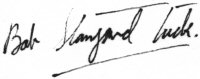 Wing Commander Bob Stanford Tuck DSO DFC** Our estimated value of this signature : £85 Died : 1987 | Wing Commander Bob Stanford Tuck DSO DFC** Bob Stanford Tuck was a flamboyant fighter pilot, his dashing good looks, courage, and success in the air coming to epitomise the young flyers who fought and won the Battle of Britain. To the British public he was a hero in the mould of the knights of old, and today his name is legend. In the early stages of the Battle of Britain Bob fought with 92 Squadron flying Spitfires, quickly becoming one of the leading aces. Promoted to command 257 Squadron, now flying Hurricanes, Bobs dashing style of leadership inspired his pilots to great success. He went on to command the Duxford and Biggin Hill Wings, taking his personal score to 29 air victories before being shot down by ground fire over Northern France in 1942. He died on 5th May 1987. |
  Captain Tommy Thompson DFC JP BOAC BA Our estimated value of this signature : £65 Died : 2008 | Captain Tommy Thompson DFC JP BOAC BA Anthony Robert Fletcher Thompson - Tommy Thompson was born on October 14th 1920. He joined the RAF VF about July 1939 as an airman under training pilot. Called up on September 1st, he completed his training at 15 EFTS and 5 FTS Sealand and arrived at 6 OTU on September 10th 1940. After converting to Hurricanes, he joined 85 (F) Squadron at Church Fenton on the 29th and moved to 249 (F) Squadron at North Weald in Essex on October 17th 1940. Thompson shared in the destruction of a Junkers Ju88 on October 28th and destroyed a Bf109 on the 30th. In May 1941 249 Squadron went to Malta and flew off of HMS Ark Royal in two groups on the 21st. On August 5th Tommy Thompson joined the Malta Night Fighting Defence Unit then formed at Ta Kali. He damaged an Italian Br20 at night on November 11th. The unit became 1435 (Night Fighter) Flight on December 23rd 1941. Thompson was posted to 71 OTU Gordons Tree, Sudan on March 3rd 1942. He returned to operations on October 1st joining 73 (F) Squadron in the Western Desert. In mid-November he was appointed A Flight Commander. At the end of December Thompson was posted to Cairo and in February he went to 206 Group as a test Pilot. He was awarded the DFC (23.03.43). On March 10th 1944 Thompson was seconded to BOAC and he took his release in Cairo on January 26th 1946 holding the rank of Flight Lieutenant. The following day he signed a contract with BOAC as a Captain. He retired from British Airways on October 14th 1975. Tommy Thompson passed away on 9th March 2008. |
  Squadron Leader Laurence Thorogood DFC AE Our estimated value of this signature : £65 Died : 2005 | Squadron Leader Laurence Thorogood DFC AE Joining 87 Squadron on June 14th 1940, Laurence Thorogood was thrown straight into the Battle of Britain, destroying a Ju88 on 25th August. Commissioned in 1941 he then was posted to India and remained in the Far East until the end of the war. He served with No 9 Sqn Indian Air Force (Hurricane IIc) and 67 Sqn RAF (Spitfire VIII) in the campaign down the Arakan Coast. Staying in the RAF after the war, he served in Singapore and Sumatra with 155 Sqn before converting to Vampires on 130 Sqn, after two years instructing on Oxfords at Middle Wallop, we was Adjutant with 615 Sqn, Biggin Hill before moving to Germany in 1951 to fly Vampires with 118 and 94 Sqns. He served on the Thor missile system before finishing his career as a civilian in Whitehall. Sadly Laurence Thorogood passed away in December 2005. We would like to thank Dr John Thorogood for supplying the photo of his father. |
  Group Captain Peter Townsend CVO, DSO, DFC Our estimated value of this signature : £90 Died : 1995 | Group Captain Peter Townsend CVO, DSO, DFC Peter Townsend was one of the most inspirational fighter leaders of the Battle of Britain. In February 1940, flying a Hurricane, he had shot down the first German aircraft to fall on English soil in World War II, and this was the first of a string of successes for the popular commander of 85 Squadron. Shot down twice, wounded, and flying part of the Battle when he couldnt walk, Peter Townsend survived to lead the first night-fighter squadron. He later became Equerry to King George VI, a post he held for 8 years. He died 19th June 1995. |
  Group Captain George H Westlake DSO DFC Our estimated value of this signature : £55 Died : 2006 | Group Captain George H Westlake DSO DFC Westlake was a student at the DeHavilland Aeronautical Technical School when he joined the RAFVR in September 1937. , George Westlake joined 43 Squadron at the height of the Battle of Britain. On 29th September he moved to 213 Squadron at Tangmere, and on 15th November shot down an Me109. In May of the following year the squadron flew their Hurricanes off HMS Furious to Malta bound for Egypt and was briefly attached to 80 Squadron during the Syrian campaign, where he had some further success. Returning to 213 Squadron he took temporary command in October 1942. In 1944 he led 239 Wing in Italy. when he was posted to 211 Group, later moving to 212 Group. He was involved with planning the invasion of Sicily and Italy and in early 1945 he was appointed Wing Leader of 239 Wing, awarded the DSO (22.6.45) .He finished the war with eleven victories. He died 18th January 2006. |
 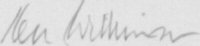 Flying Officer Ken Wilkinson Our estimated value of this signature : £45 Died : 2017 | Flying Officer Ken Wilkinson Battle of Britain pilot flying Hurricanes, he flew Spitfires with 611 Sqn and then 616 Sqn at Kirton-in-Lindsey and 19 Sqn at Fowlmere during 1940 and after a spell instructing returned to operations on Spitfires, with 234 and 165 Squadrons. After spending time with 53, 24 and 10 Operational Training Units, he left the RAF in November 1945 and served in the RAFVR. Ken said : From 1st September 1939 I wrote myself off. I thought, 'you've got no chance' lasting through whatever is going to be. It was quite obvious, in the way the Germans were moving, they were going to make a hell of a war out of it, so I was ready for war. I can remember saying 'we've got to stop this fellow Hitler'. When you think of all the thousands of citizens that were being killed by this absurd bombing. They had to pay for it didn't they. Yes, we lost people. Friends that didn't come back. I don't think we were the sort of people to brood over it, ever. You have to get into an attitude to make sure that you're as cold as a fish. Once someone has failed to return, that's it. Fortune smiled on me and not on some of the others. I can only say that whoever it was who popped off at me, wasn't a very good marksman. It transpired that we were doing something far more important than we thought. As far as we were concerned, it was just that there were some untidy creatures from over the other side of the channel, trying to bomb England and the United Kingdom. And we didn't want them to bomb us. After all, we never asked the Germans to start this nonsense, did we? But they did, and we had to stop them, and we did. It's our country. You die for you country. |
| Hurricane Squadron details |
No.1 Sqn RAF Country : UK Known Codes : , JX, NA, | No.1 Sqn RAF In Omnibus Princeps - First in all things |
No.111 Sqn RAF Country : UK Known Codes : , JU, TM, | No.111 Sqn RAF Adstantes - Standing by |
No.112 Sqn RAF Country : UK Disbanded 1st July 1957 Known Codes : , DY, GA, RT, XO, | No.112 Sqn RAF Swift in destruction |
No.126 Sqn RAF Country : UK Disbanded 10th March 1946 Known Codes : , 5J, MK, MT, TD, | No.126 Sqn RAF Persian Gulf Foremost in attack |
No.135 Sqn RAF Country : UK Disbanded 10th June 1945 Known Codes : , WK, | No.135 Sqn RAF Pennas ubique monstramus - We show our wings everywhere |
No.151 Sqn RAF Country : UK Disbanded September 1992 Known Codes : , DZ, GG, | No.151 Sqn RAF Foy pour devoir - Fidelity unto duty |
No.17 Sqn RAF Country : UK Known Codes : , YB, UT, UV, | No.17 Sqn RAF Excellere contende - Strive to excel |
No.181 Sqn RAF Country : UK Disbanded 30th September 1945 Known Codes : , EL, | No.181 Sqn RAF Irruimus vastatum - We rush in and destroy |
No.242 Sqn RAF Country : UK Disbanded 30th September 1964 Known Codes : , LE, | No.242 Sqn RAF Canadian Toujours pret - Always ready |
No.247 Sqn RAF Country : UK Disbanded 31st December 1963 Known Codes : , HP, ZY, | No.247 Sqn RAF China-British Rise from the east |
No.248 Sqn RAF Country : UK Disbanded 30th September 1946 Known Codes : , RK, DM, WR, | No.248 Sqn RAF Il faut en finir - It is necessary to make an end of it |
No.249 Sqn RAF Country : UK Disbanded 24th February 1969 Known Codes : , GN, | No.249 Sqn RAF Gold Coast Pugnis et cacibus - With fist and heels |
No.253 Sqn RAF Country : UK Disbanded 1st September 1957 Known Codes : , SW, | No.253 Sqn RAF Hyderabad State Come one, come all |
No.257 Sqn RAF Country : UK Disbanded 31st December 1963 Known Codes : , DT, A6, FM, | No.257 Sqn RAF Burma Thay myay gyee shin shwe hti - Death or glory |
No.274 Sqn RAF Country : UK Disbanded 7th September 1945 Known Codes : , JJ, | No.274 Sqn RAF Supero - I oversome |
No.29 Sqn RAF Country : UK Known Codes : , RQ, YB, RO, | No.29 Sqn RAF Impiger et acer - Energetic and keen |
No.3 Sqn RAF Country : UK Known Codes : , QO, JF, J5, OP, | No.3 Sqn RAF Tertius primus erit - The Third shall be first |
No.32 Sqn RAF Country : UK Known Codes : , GZ, KT, | No.32 Sqn RAF Adeste comites - Rally round, comrades |
No.331 Sqn RAF Country : UK Disbanded 21st November 1945 Known Codes : , AR, FN, | No.331 Sqn RAF Norwegian For Norge - For Norway |
No.402 Sqn RCAF Country : Canada Disbanded 24th July 1945 Known Codes : , AE, | No.402 Sqn RCAF City of Winnipeg We stand on guard |
No.43 Sqn RAF Country : UK Known Codes : , FT, NQ, SW, | No.43 Sqn RAF Gloria finis - Glory is the end |
No.450 Sqn RAAF Country : Australia Disbanded 20th August 1945 Known Codes : , OK, PD, | No.450 Sqn RAAF Harass |
No.46 Sqn RAF Country : UK Disbanded 31st August 1975. Known Codes : , FH, PO, RJ, XK, | No.46 Sqn RAF Uganda We rise to conquer |
No.501 Sqn RAF Country : UK Disbanded 10th March 1957 Known Codes : , SD, RAB, ZH, | No.501 Sqn RAF County of Gloucester, City of Bristol (Auxiliary) Nil time - Fear nothing |
No.54 Sqn RAF Country : UK Known Codes : , KL, DL, HF, | No.54 Sqn RAF Audax omnia perpeti - Boldness to endure anything |
No.56 Sqn RAF Country : UK Known Codes : , US, LR, ON, | No.56 Sqn RAF Punjab Quid si coelum ruat - What if heaven falls |
No.6 Sqn RAF Country : UK Known Codes : , JV, NI, XE, ZD, | No.6 Sqn RAF Oculi exercitus - The eyes of the army |
No.601 Sqn RAF Country : UK Disbanded 10th March 1957 Known Codes : , UF, HT, YN, | No.601 Sqn RAF County of London (Auxiliary) |
No.610 Sqn RAF Country : UK Disbanded 10th March 1957 Known Codes : , DW, JE, | No.610 Sqn RAF County of Chester (Auxiliary) Alifero tollitur axe ceres - Ceres rising in a winged car |
No.73 Sqn RAF Country : UK Disbanded 17th March 1969 Known Codes : , TP, HV, | No.73 Sqn RAF Tutor et ultor - Protector and avenger |
No.74 Sqn RAF Country : UK Known Codes : , GM, JH, 4D, ZP, | No.74 Sqn RAF Trinidad I fear no man |
No.79 Sqn RAF Country : UK Disbanded (renumbered) 1st January 1962 Known Codes : , AL, NV, | No.79 Sqn RAF Madras Presidency Nil nobis obstare potest - Nothing can stop us |
No.85 Sqn RAF Country : UK Disbanded 19th December 1975 Known Codes : , VY, NO, | No.85 Sqn RAF Noctu diuque venamur - We hunt by day and night |
No.87 Sqn RAF Country : UK Disbanded 3rd January 1961 Known Codes : , LK, PD, | No.87 Sqn RAF United Provinces Maximus me metuit - The most powerful fear me |
No.92 Sqn RAF Country : UK Disbanded 1st October 1994 Known Codes : , GR, QJ, DL, 8L, | No.92 Sqn RAF East India Aut pugna aut morere - Either fight or die |
|
Contact Details |
|
Sign Up To Our Newsletter!
This website is owned by Cranston Fine Arts. Torwood House, Torwoodhill Road, Rhu, Helensburgh, Scotland, G848LE Contact: Tel: (+44) (0) 1436 820269. Email: cranstonorders -at- outlook.com |
 |


