|
|
|
|
|
|
|
|

|
Don't Miss Any Special Deals - Sign Up To Our Newsletter!
| ||||||||||||||||
| CLICK HERE FOR A FULL LIST OF ALL IVAN BERRYMAN PRINTS BY TITLE |
|
The Battles of Admiral Nelson
Ivan Berryman Art  Nelson's Battles Nelson's Battles |
[UP] - Aviation Art - Royal Navy - US Navy - German Navy - French Navy - Italian Navy - Spanish Navy - Maritime Art - Nelson's Battles - Motor Racing - Railways and Steam - Original Acrylic Paintings - Star Wars Art - Postcards - Paintings in Progress |
| Naval
art prints of the Age of Sail, the era of the Battle of Trafalgar,
Battle of Copenhagen and Battle of the Nile. Gallery of historic
naval art prints by naval artist Ivan Berryman depicting the battles of
Nelson and his adversaries, and all other prints of this era.
Click the links below to go to galleries featuring prints of the
individual battles, or see the complete list below.
Ivan Berryman aboard HMS Victory doing detailed photographic research with special permission, 2003.
The battle of Trafalgar took place at the Cape of Trafalgar, 80 KM west of Cadiz, British Victory over the French and Spanish Navy's, with the British losses being the Vice Admiral Lord Horatio Nelson who was killed in the action, and some 1596 Officers and Men, killed or wounded. The French and Spanish losses were much higher with both the French Rear Admiral Charles Magon and the Spanish Admiral Don Frederico Gravina killed, plus some 2,600 officers and men killed or wounded and a total of 4,400 captured. |
||
| Navigation | |
| Page 3 of 4 | Previous .. Page 3 .. Next |
|
|
|
|
|
|
|
|
|
|
|
|
|
|
|
|
|
|
|
|
|
| Navigation | |
| Page 3 of 4 | Previous .. Page 3 .. Next |
| Text for the above items : |
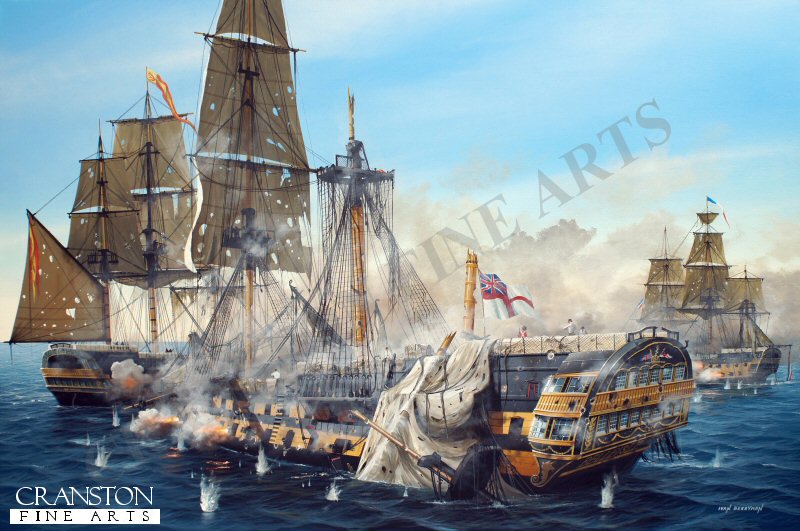
Warm Work by Ivan Berryman. The time is approximately 12.20pm on 21st October 1805. HMS Victory forces her way through the combined Spanish and French line, firing all her larboard guns into the stern of Admiral Villeneuve’s flagship. Bucentaure was utterly destroyed by the initial salvo with twenty of her guns smashed off their mounts and over 300 of her crew left dead or disabled. But Victory herself had suffered much during the perilous approach to the enemy fleet. Unable to bring any guns to bear, she received multiple hits from the Franco-Spanish ships, bringing down her mizzen top, her fore topgallant mast, her studding sails and smashing the ship’s wheel. The bowsprit, part of her figurehead and catheads were shattered, her anchors carried away and the entire bow, headrails and beakhead were peppered with shot. The title of the painting refers to a comment made by Admiral Horatio Nelson as HMS Victory began to receive fire from the enemy. A piece of hot shrapnel tore the buckle off Nelson’s shoe as he paced the deck with Captain Hardy, to which he responded, “It is warm work today!” Sadly, just one hour later, Nelson was fatally wounded by a sharpshooter stationed on the mizzen top of the French Redoutable which can be seen to the left of the painting. The towering spectre of HMS Temeraire looms in the gunsmoke as she follows HMS Victory into the fray. |
HMS Speedy - Cochranes Action Against the Gamo by Ivan Berryman On 6 May 1801, HMS Speedy was cruising off the Spanish Coast when a large enemy frigate was sighted, a xebec-rigged vessel named Gamo, commanded by Don Francisco de Torres. Instead of evading the Spanish ship, which was carrying seven times the firepower of the tiny Speedy, Captain Thomas John Cochrane instead brought his ship so close to the Spanish frigate that the Spanish were unable to bring their guns to bear, whilst Speedy was able to fire repeatedly up through the Gamos hull and decks, de Torres being killed in the opening broadside. After repelling boarders, Cochrane despatched his entire crew, bar the ships doctor, to seize the Gamo and take her as a prize, tearing down the Spanish colours to convince her crew that she had struck and fallen to their tiny British opponent. |
A 74 Alongside by Ivan Berryman A 74 gun ship of the line alongside at twilight with a small crowd enjoying some local hospitality. |
Nerves of Steel by Ivan Berryman. Just moments from her devastating opening broadside, HMS Victory prepares to pass the stern of the French flagship, Bucentaure, to break through the line of the combined French and Spanish fleets as the Battle of Trafalgar begins on 21st October 1805. Victorys guns had remained silent until this moment, Lord Nelsons flagship having already suffered severe damage during the approach, but now the gun crews awaited the moment when her double-shotted cannon, her mighty 68-pounder carronade and a shower of musket balls would smash through the French vessel, rendering it at once a useless hulk. |
Trafalgar: HMS Royal Sovereign Prepares to Break the Line by Ivan Berryman. Just minutes from opening fire, HMS Royal Sovereign, carrying the flag of Vice-Admiral Lord Cuthbert Collingwood, approaches the Franco-Spanish line at Trafalgar, prior to breaking through and delivering a devastating broadside into the black-painted Santa Ana. Royal Sovereign had already taken terrible punishment as it had approached the enemy line, unable to bring her own guns to bear. Ships depicted, left to right, are: Indomptable (Fr) Rhin (Fr) Santa Ana (Sp) Royal Sovereign (Br) and Fougeux (Fr) |
Breaking the Line by Ivan Berryman. Just seconds from opening fire with a broadside that will devastate her opponent, HMS Victory prepares to pass the stern of the French flagship Bucentaure, closely followed by the three-deckers HMS Temeraire and HMS Neptune. With guns unable to bear on the enemy fleet during the slow approach the British ships had endured terrible punishment with Victorys sails holed, her wheel smashed and her mizzen top shot away. |
The Good Old Temeraire by Ivan Berryman. (PC) The hero of Trafalgar, HMS Temeraire, is depicted here at sea as she was originally constructed, with her simple scroll figurehead, and the yellow hull that was typical of the period. She has her studding sails set on the mainmast to help make all speed as she punches through the heavy swell of the English Channel. For Trafalgar, Temeraire was repainted with the 'Nelson Chequer' pattern that can be seen on HMS Victory today, this magnificent ship coming to the latter's rescue whilst fighting on with a prize lashed to each of her sides. Post Trafalgar, her crew raised enough money from their prizes to have a new figurehead carved which she carried proudly even to the scrap yard at Rotherhithe in 1838, where she was broken up. |
Moonlight Despatch by Ivan Berryman. (PC) The role of the frigate in Nelson's navy was one of the most varied of all the ships of the line, but their great speed made them ideal as communications vessels, carrying vital despatches between ships, squadrons and the Admiralty. |
The Battle of Trafalgar, 2.30pm. The Taking of the Santisima Trinidad by Ivan Berryman Dominating the centre foreground, the wreck of the largest ship at Trafalgar, the massive four decker Santisima Trinidad (130 guns), comes under further attack from the British Neptune (98 guns) All her masts have fallen, rendering the Spanish giant an unmanageable hulk. Elsewhere, the battle rages on with Temeraire and Victory engaged with the French Redoubtable, while to the right of the picture, the shattered, drifting remains of Villeneuves Bucentaure (80 guns) is approached by the Mars (74 guns) Conqueror (74 guns), off the Santisima Trinidads port quarter, is keeping up a distant fire to assist the Neptune. |
The Tenacious Belleisle by Ivan Berryman. Few ships fought more bravely than HMS Belleisle at the Battle of Trafalgar. Having been second in the line of Collingwood’s leeward division, the 74-gun Belleisle took on a number of opponents including the Monarca, Santa Ana and Indomtable, but soon found herself surrounded by enemy ships that poured weighty broadsides into her. By 2.30 in the afternoon, Bellisle was little more than a floating wreck, having lost all of her masts and bowsprit, yet still she fought bravely on, her colours flying defiantly from the stump of her mizzen mast. Belleisle survived her ordeal and was towed to Gibraltar after the battle where temporary repairs were made, arriving in Plymouth for a refit on 5th December 1805. |
Line of Battle by Ivan Berryman. As Nelsons column of ships began their approach to the French and Spanish fleet at the start of the Battle of Trafalgar on 21st October 1805, the first four ships to break through were to be HMS Victory at the head of the line, HMS Temeraire, HMS Neptune and the 74-gun two-decker HMS Leviathan. Afraid for his admirals safety in the lead ship, Captain Harvey of the Temeraire decided to break away from the line in order to overtake Victory and be the first ship through, thus taking the worst of the gunfire from the enemy line as they approached. However, it was admiral Nelsons habit always to lead from the front and, as Temeraire manoeuvred alongside Victory, Nelson took up his speaking trumpet, went to his ships side and sternly shouted "I will thank you, Captain Harvey to maintain your proper station which is astern of the Victory". Harvey comlpied at once and the fleet continued into battle as originally planned. |
HMS Eurydice at Anchor off Cowes by Ivan Berryman After being re-commissioned under the command of Captain Marcus Augustus Stanley Hare, Eurydice sailed from Portsmouth on a three-month tour of the West Indies and Bermuda on 13th November 1877. On 6th March 1878, she began her return voyage from Bermuda for Portsmouth. After a very fast passage across the Atlantic, on 24 March 1878, Eurydice was caught in a heavy snow storm in Sandown Bay, within sight of the Isle of Wight, capsized and sank. Only two of the ship's 319 crew and trainees survived. Most of those who were not carried down with the ship died of exposure in the freezing waters. One of the witnesses to the disaster was a young Winston Churchill, who was staying at Ventnor with his family at the time. The wreck was re-floated later that same year but had been so badly damaged during her submersion that she was then subsequently broken up. Her ship's bell is preserved in St. Paul's Church, Gatten, Shanklin. There is a memorial in the churchyard at Christ Church, The Broadway, Sandown and the ship's anchor is set into a memorial at Clayhall Cemetery, Gosport. |
HMS Agamemnon by Ivan Berryman. Considered by Lord Nelson as The finest 64 in the Service - indeed, his favourite ship, HMS Agamemnon was a two-deck third rate warship, lighter and faster than most 74s. Launched at Bucklers Hard in 1781, she saw action in many great battles, among them the Battle of Ushant, the Battle of Copenhagen and Trafalgar, by which time she was a veteran of 24 years service. |
Trafalgar by Ivan Berryman. (PC) By 2.00pm on 21st October 1805, the Battle of Trafalgar was all but won, the combined French and Spanish fleets had suffered terrible losses, but not without great cost to the British. Admiral Lord Horatio Nelson lay dying in the cockpit of his flagship, Victory, having been struck down by a single musket round fired from the fighting top of the French Redoutable's mizzen mast as Nelson walked on deck with Captain Hardy. In this scene, the battered remains of Victory can be seen beneath the figurehead of the Spanish 74 Principe de Asturias which dominates the foreground. Beside her, the hulk of the Redoutable sags in the water as Temeraire breaks free. In the centre, the British 74 Leviathan is engaging the French 80-gun Neptune, whilst the San Augustin can be seen firing at the extreme right of the picture. |
Riding the Ninth Wave by Ivan Berryman. (P) Sailors on a clipper during a storm. |
Fire in the Night - The Battle of the Nile, 1798 by Ivan Berryman. (PC) The painting depicts the French ships Franklin and Peuple Souverain taking heavy fire from HMS Defence (centre) with HMS Minotaur in her wake, whilst Nelson in HMS Vanguard can be seen behind them. Other French ships, Spartiate and Conquerant can also be seen through the gap. On the far side of Franklin and Peuple Souverain, the masts and sails of the British ship Orion can be seen as she rakes the French line from the far side. |
HMS Captain and HMS Southampton, 1796 by Ivan Berryman. The 74 gun HMS captain, flying the flag of Commodore Horatio Nelson, lies at anchor at Sound Rock, Bahamas, in company with the 32-gun frigate HMS Southampton in 1796. |
Broadside - HMS Victory by Ivan Berryman. HMS Victory unleashes a fearsome broadside volley. During the ship's most famous battle at Trafalgar, the four decks carried over 100 guns in total, with each broadside capable of firing over a ton of cannonballs. |
USS Constitution - 'Old Ironsides' by Ivan Berryman. Launched in 1797, the USS Constitution was the third of her class to be constructed at Edmund Hartt's shipyard in Boston, Massachusetts, this fine ship spending most of her early years in local waters, protecting merchantmen from French marauders. She is best remembered, however, for her decisive conquests against British ships during the war of 1812, among them the Guerriere against whom the Constitution gained her nickname 'Old Ironsides'. She continued to serve until 1881 and is still afloat today, the oldest seagoing warship in the world. |
The Fighting Temeraire by Ivan Berryman. Few ships availed themselves better at the Battle of Trafalgar on 21st October 1805 than HMS Temeraire. Here, she is depicted engaging the French Fougeuex, the two ships inflicting the most terrible damage upon one another in the early stages of the battle. Some crew members can be seen on Temeraire’s foredeck, trying to cut away the fallen fore yard and sail while her fore topsail flaps helplessly above after being set on fire. The acrid gun smoke soon became so bad that Captain Harvey ordered the Temeraire’s larboard guns to stop firing briefly so that he could check that he was not firing on his own ships. Temeraire would eventually take both the Fougeuex and The Redoutable as prizes, at one point having one enemy ship lashed to each side of her hull. As an aside, Temeraire was most likely the only ship at Trafalgar to have no figurehead. Having been built during a more austere period, she lacked much of the decoration of her contemporaries. It is believed, however, that her crew funded a figurehead after the battle from their own prize money, as a ship with no figurehead was considered a ship with no eyes and no soul. A modest crowned head featured at her bow until she was broken up at Beatson’s Yard in Rotherhithe between 1838 and 1839. |
Bucentaure by Ivan Berryman. Built at Toulon in 1803, Bucentaure was the flagship of Admiral Villeneuve at the Battle of Trafalgar on 21st October 1805 and the first to be almost completely disabled by a massive broadside from HMS Victory as Nelson broke through the enemy line. Bucentaure was taken as a prize by the British fleet, but was lost in the great storm that followed the battle. |
|
Contact Details |
|
Sign Up To Our Newsletter!
This website is owned by Cranston Fine Arts. Torwood House, Torwoodhill Road, Rhu, Helensburgh, Scotland, G848LE Contact: Tel: (+44) (0) 1436 820269. Email: cranstonorders -at- outlook.com |
 |