|
|
|
|
|
|
|
|

|
Don't Miss Any Special Deals - Sign Up To Our Newsletter!
| ||||||||||||||||
| CLICK HERE FOR A FULL LIST OF ALL IVAN BERRYMAN PRINTS BY TITLE |
|
The Battles of Admiral Nelson
Ivan Berryman Art  Nelson's Battles Nelson's Battles |
[UP] - Aviation Art - Royal Navy - US Navy - German Navy - French Navy - Italian Navy - Spanish Navy - Maritime Art - Nelson's Battles - Motor Racing - Railways and Steam - Original Acrylic Paintings - Star Wars Art - Postcards - Paintings in Progress |
| Naval
art prints of the Age of Sail, the era of the Battle of Trafalgar,
Battle of Copenhagen and Battle of the Nile. Gallery of historic
naval art prints by naval artist Ivan Berryman depicting the battles of
Nelson and his adversaries, and all other prints of this era.
Click the links below to go to galleries featuring prints of the
individual battles, or see the complete list below.
Ivan Berryman aboard HMS Victory doing detailed photographic research with special permission, 2003.
The battle of Trafalgar took place at the Cape of Trafalgar, 80 KM west of Cadiz, British Victory over the French and Spanish Navy's, with the British losses being the Vice Admiral Lord Horatio Nelson who was killed in the action, and some 1596 Officers and Men, killed or wounded. The French and Spanish losses were much higher with both the French Rear Admiral Charles Magon and the Spanish Admiral Don Frederico Gravina killed, plus some 2,600 officers and men killed or wounded and a total of 4,400 captured. |
||
| Navigation | |
| Page 4 of 4 | Previous .. Page 4 |
|
|
|
|
|
|
|
|
|
|
|
| Navigation | |
| Page 4 of 4 | Previous .. Page 4 |
| Text for the above items : |
Hearts of Oak Ivan Berryman. It is September 18th, 1805, off Plymouth. Led by the 74-gun HMS Thunderer, with HMS Ajax astern, HMS Victory, with Admiral Lord Horatio Nelson aboard, begins her journey south to join the rest of the British fleet off Cadiz where the combined French and Spanish fleets lay blockaded. This was the prelude to the Battle of Trafalgar and the last time Nelson would see his beloved England. |
Prelude to Trafalgar by Ivan Berryman. 21st October 1805. As Admiral Nelsons flagship leads the British fleet towards the Franco-Spanish line, Captain Harveys Temeraire tries to pass the Victory in order to be the first to break the enemy column. Harvey was discouraged with a customry rebuke from Nelson and duly fell into line behind the flagship. The enemy can be seen spread along the horizon whilst, to the right in the distance, the leading ships of Admiral Collingwoods fleet can be seen spearheading a separate assault to the south. In the light airs preceding the battle, much sail was needed to drive the British ships towards the enemy line. HMS Victory, nearest, has royals and stunsails set and is making good way, her furniture boats strung behind in readiness for battle. On her poop deck, officers prepare to run up a signal. |
Cutty Sark and Thermopylae by Ivan Berryman. Cutty Sark and Thermopylae racing each other home in 1872. Cutty Sark is nearest with her sails backlit against the low sun and her great rival Thermopylae in the distance. |
HMS Victory Departing Portsmouth by Ivan Berryman. Nelson's flagship at the Battle of Trafalgar is depicted here passing the iconic Round Tower at the entrance to Portsmouth Harbour before dropping anchor at Spithead in readiness for her next voyage. With her is the sloop HMS Pickle, also a veteran of Trafalgar, who carried Admiral Collingwood's victory despatch to the Admiralty after the great battle had been won. |
Frigate Action off Antigua by Ivan Berryman. HMS Boreas encounters the French Compas, August 29th 1779. |
USS United States by Ivan Berryman. (PC) Still showing some signs of her encounter with HMS Macedonian on 25th October 1812 and under the command of Captain Stephen Decatur, USS United States is shown surging through a heavy Atlantic swell en route for Newport, Rhode Island, which she would eventually reach on 4th December, in company with the Macedonian, who she had so decisively defeated and taken as a prize. |
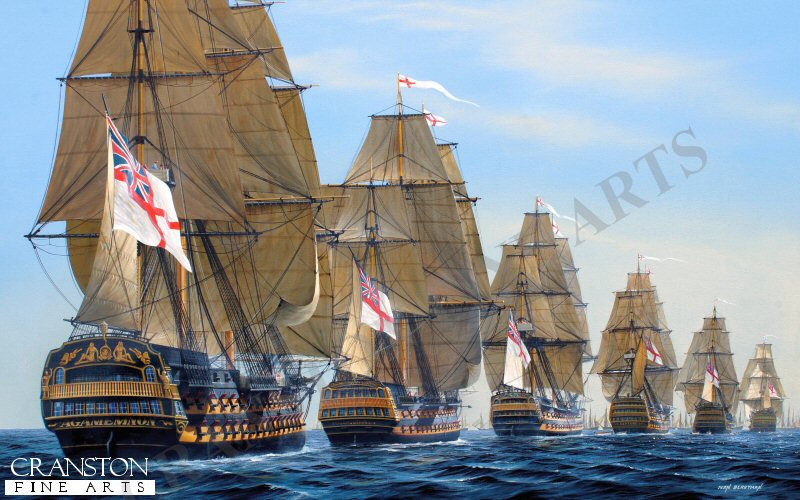
In Destinys Hands, Trafalgar, 12:15 PM by Ivan Berryman It is approximately 12,15 pm on 21st October 1805. With the combined Franco-Spanish enemy line in the far distance, HMS Victory is just beginning to manouevre, having chosen the French flagship Bucentaure as her target. Behind Victory lies Temeraire, then Neptune, followed by the two-deckers, Leviathan and Conqueror and Agamemnon in the foreground. Victory is flying the signal Engage the Enemy Closely from her main mast. Most ships have their studding sails set on the larboard (port) side only trying to harness as much wind as possible to hasten their approach 1n such light airs. At this stage, the stoves will have been extinguished, the guns run out and all decks cleared for action, their floors strewn with sawdust to avoid slipping and to soak up the blood. The Marines will be in position the officers at their posts and gun crews may likely have been singing hearty songs to raise their spirits. Fate alone knew what awaited them, once the firing started. |
Battle of Trafalgar by Ivan Berryman. One of the most decisive battles in the history of the Royal Navy, Nelsons defeat of the French fleet took place on 21st October 1805 off Cape Trafalgar and was conducted with not a single British ship lost, although few ships escaped severe punishment and loss of life on both sides was tragically high |
HMS Temeraire Departing Plymouth by Ivan Berryman. One of the most iconic ships ever to serve in the Royal Navy, The three-decked second rate HMS Temeraire was built at Chatham in 1798 and spent many years blockading the French port of Brest before her finest hour at Trafalgar on 21st October 1805 when she came to the rescue of HMS Victory before capturing two prizes, the Redoutable and Fougueux, spending much of the battle with her captives lashed to her sides. After spending her final years first as a prison hulk, then as a guard ship in the Medway, she was finally sold for scrap in 1838, her last journey being the subject of JMW Turner's most famous painting. In this view, Temeraire is shown leaving Plymouth in her pre-Trafalgar state before receiving her 'crowned head' figurehead. |
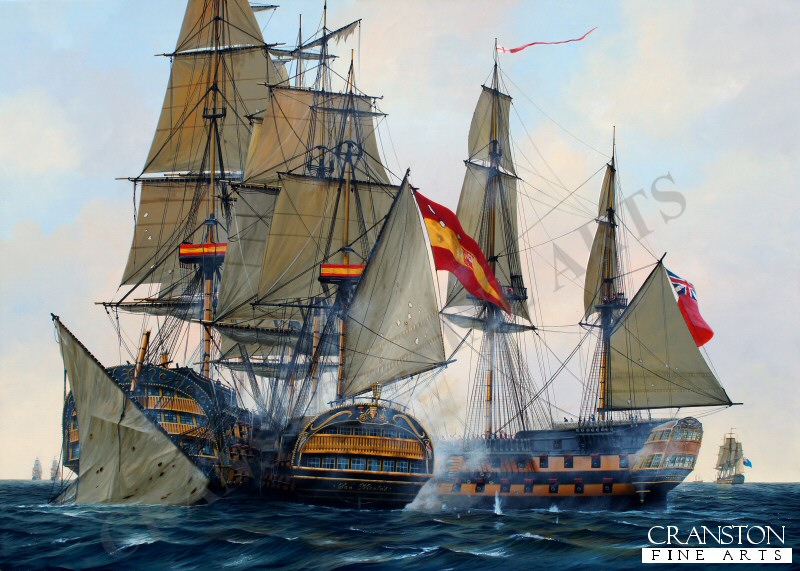
The Battle of Cape St Vincent - Nelsons Patent Bridge by Ivan Berryman. As the early morning fog and mist began to clear on 14th February 1797, the British squadron commanded by Admiral Jervis spotted two columns of Spanish ships and immediately set off in pursuit. Horatio Nelson was stationed at the very rear of the British squadron in HMS Captain and, from this vantage point Nelson suspected that the Spanish would form into a single fighting unit and he feared that they would attempt to encircle the British ships and attack them in the round. Against orders to the contrary, Nelson broke away and sailed directly at the Spanish line to intercept them. A fierce artillery battle ensued with the San Josef losing her mizzen mast and HMS Captain having her fore top shot away. Damage to the San Nicolas was such that she became uncontrollable and crashed heavily into the San Josef, at which point Nelson drove his ship into the pair of them, personally leading the boarding party to take both ships as prizes. This daring manoeuvre became known as Nelsons Patent Bridge for Boarding First Rates and alerted the Admiralty to young Nelsons bravado and courage. |
Captain Harveys HMS Temeraire tries to pass HMS Victory at the beginning of the Battle of Trafalgar by Ivan Berryman. 21st October 1805. As Admiral Nelsons flagship leads the British fleet towards the Franco-Spanish line, Captain Harveys Temeraire tries to pass the Victory in order to be the first to break the enemy column. Harvey was discouraged with a customry rebuke from Nelson and duly fell into line behind the flagship. The enemy can be seen spread along the horizon whilst, to the right in the distance, the leading ships of Admiral Collingwoods fleet can be seen spearheading a separate assault to the south. In the light airs preceding the battle, much sail was needed to drive the British ships towards the enemy line. HMS Victory, nearest, has royals and stunsails set and is making good way, her furniture boats strung behind in readiness for battle. On her poop deck, officers prepare to run up a signal. |
|
Contact Details |
|
Sign Up To Our Newsletter!
This website is owned by Cranston Fine Arts. Torwood House, Torwoodhill Road, Rhu, Helensburgh, Scotland, G848LE Contact: Tel: (+44) (0) 1436 820269. Email: cranstonorders -at- outlook.com |
 |